
Categories: RF Absorbers

by 3PB Team

Share

Categories: RF Absorbers

by 3PB Team

Share

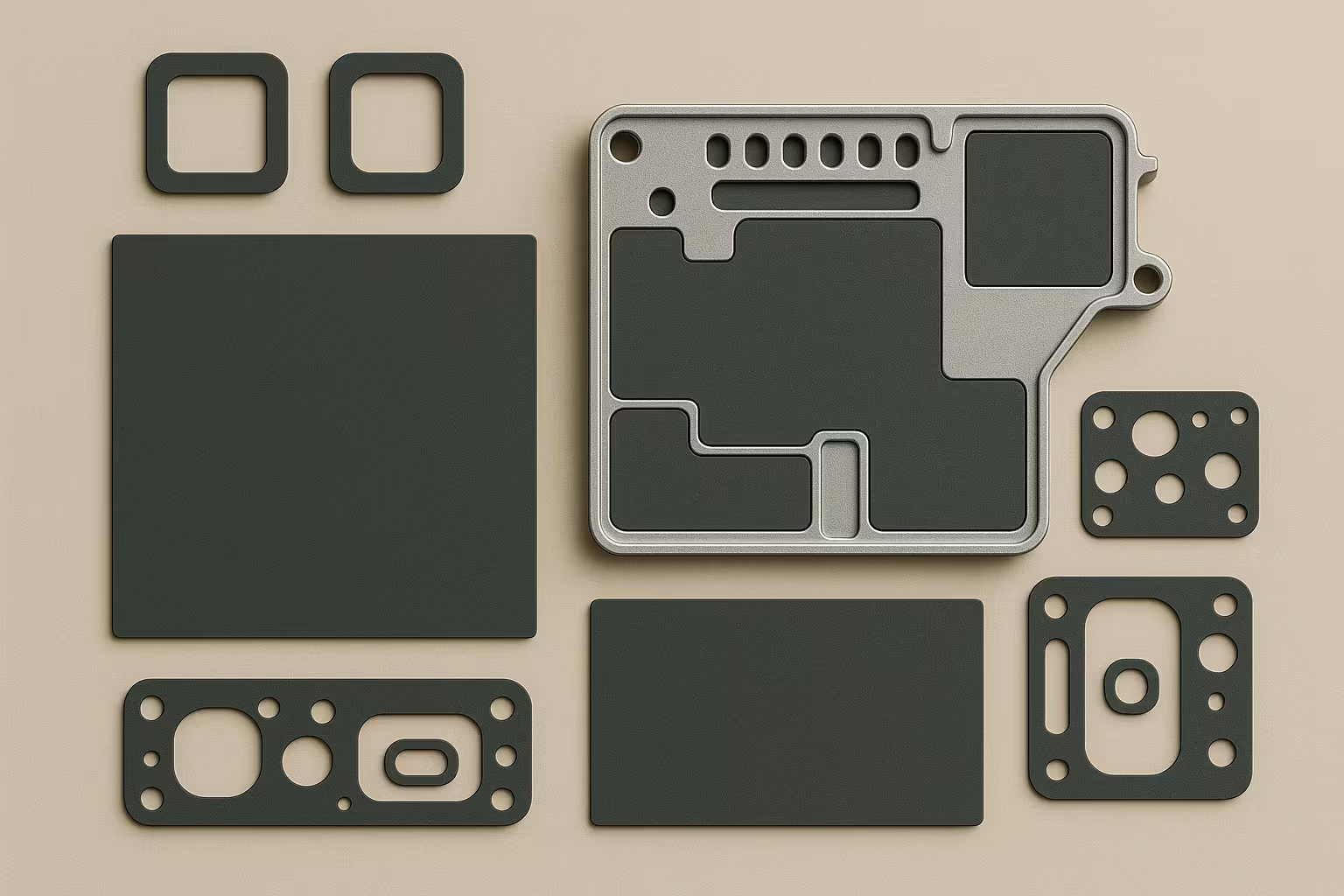
PIM mitigation RF absorber material installed on cellular antenna for backlobe suppression

Short version: Most RF absorber materials on the market use silicone as the base elastomer. That’s a problem for any application where silicone outgassing or contamination is a disqualifier. The 3PB Solutions US Series is a magnetic-loaded acrylic elastomer that provides RF absorption from 0.5 to 18 GHz with zero silicone content. No siloxane migration, no low-molecular-weight silicone outgassing, no contamination risk. Request a free sample kit or keep reading for the full technical details.


The Silicone Problem in RF Absorbers

Silicone is the default base material for RF absorber sheets. It’s flexible, stable across a wide temperature range, and easy to load with magnetic filler particles. Nearly every major absorber manufacturer builds their product line on silicone elastomers. Eccosorb™, BandSorb™, and most other branded absorber lines are silicone-based.

For the majority of applications, silicone works fine. But there’s a significant minority of applications where silicone is a serious problem, and if you’re reading this, you probably already know which category you’re in.

Silicone elastomers outgas low-molecular-weight (LMW) siloxanes. These volatile compounds migrate from the material surface and deposit on nearby surfaces as a thin, invisible film. The process is continuous and accelerates with temperature. Once deposited, silicone contamination is extremely difficult to remove and can permanently degrade the performance of sensitive components.

Industries That Restrict or Ban Silicone

Optics and photonics. Silicone contamination deposits on lenses, mirrors, sensors, and optical coatings. The film degrades light transmission, alters reflectivity, and can permanently damage anti-reflective coatings. Laser systems are particularly vulnerable because the contamination film can absorb laser energy and cause localized damage. Many optical assembly facilities have outright bans on silicone-containing materials anywhere in the production environment.

Aerospace and satellite systems. Outgassing is a critical concern for anything going into orbit or operating in vacuum. Silicone materials that outgas in a sealed spacecraft cabin or satellite enclosure deposit contaminants on optics, solar panels, thermal control surfaces, and sensitive electronics. NASA maintains the ASTM E595 outgassing database specifically to screen materials for space applications, and many aerospace prime contractors maintain their own restricted materials lists that exclude silicone.

Medical devices. Silicone contamination can interfere with adhesive bonding, coating adhesion, and surface treatments on medical devices. In applications involving optical sensors, imaging systems, or laser-based instruments, the same contamination issues that affect photonics apply. Some medical device manufacturers ban silicone from their production floors entirely to avoid cross-contamination.

Semiconductor manufacturing. Cleanroom environments in semiconductor fabs are highly sensitive to molecular contamination. Silicone outgassing can deposit on wafer surfaces, mask optics, and process equipment. Even trace amounts of silicone contamination can cause defects in lithographic processes.

Automotive lidar and camera systems. Advanced driver assistance systems (ADAS) rely on cameras, lidar, and radar sensors that are sensitive to optical contamination. Silicone outgassing from materials inside sensor housings can fog lens surfaces and degrade performance over time, especially in the elevated temperatures common in automotive environments.

Adhesive bonding applications. Silicone contamination on surfaces that need to be bonded, painted, or coated causes adhesion failures. If an absorber is placed near a bond line or in an enclosure where other components will later be adhesive-bonded, silicone outgassing can compromise those bonds.

The 3PB Solutions US Series: An Acrylic Alternative

The US Series is a proprietary magnetic-loaded acrylic elastomer. The base material is acrylic, not silicone. It contains zero silicone content and produces no siloxane outgassing.

The magnetic filler is a proprietary high-permeability formulation that provides broadband RF absorption. The material is designed for 0.5 to 3.0 GHz peak performance, but it has been fielded successfully in applications up to 18 GHz. This makes it effective across a wide range of cavity sizes and resonance frequencies without needing to precisely match the material to a specific band.

Key specifications:

Base material: Acrylic elastomer (non-silicone, no siloxane outgassing)

Frequency range: 0.5 to 3.0 GHz (designed), fielded to 18 GHz

Available thicknesses: 0.010″, 0.020″, 0.040″

Adhesive: Available with or without pressure-sensitive adhesive (PSA). Approximately 90% of customers use the PSA-backed version.

Stacking: Sheets can be stacked to increase low-frequency performance. Two layers of 0.040″ provides useful absorption below 0.5 GHz.

Compliance: RoHS and REACH compliant. UL 94 flammability data available (internal test reports).

Complex permeability and permittivity data: Available for electromagnetic simulation in HFSS, CST, and COMSOL. Email our engineering team to request simulation data.

Why Acrylic Instead of Silicone?

The choice of acrylic as the base elastomer wasn’t arbitrary. Acrylic provides several specific advantages over silicone for RF absorber applications beyond just the absence of outgassing.

No siloxane migration. The primary advantage. Acrylic does not contain or release siloxane compounds. There is no molecular contamination risk to adjacent optics, bond surfaces, sensors, or sensitive components. The material can be used in cleanrooms, optical assemblies, and sealed enclosures where silicone is prohibited.

Excellent PSA adhesion. The acrylic base is inherently compatible with acrylic-based pressure-sensitive adhesives. Silicone elastomers, by contrast, can cause adhesion problems with standard PSA systems because the migrating silicone oil weakens the bond over time. The US Series PSA bond remains stable.

Dimensional stability. Acrylic elastomers maintain their dimensions and mechanical properties over time without the plasticizer migration that can occur in some silicone formulations. The material doesn’t shrink, swell, or change hardness over its service life.

Lower cost. The US Series is generally the most cost-effective absorber in the 3PB Solutions product line. This isn’t a premium-priced specialty material. It typically costs less than the silicone-based series at comparable thicknesses and quantities, which makes it practical for high-volume applications and for the proactive “absorber on every lid” approach to cavity resonance suppression.

When the US Series Is the Right Choice

Any application that restricts or bans silicone. If your materials specification, process control document, or customer requirements prohibit silicone, the US Series is a direct solution. No waivers, no risk assessment, no contamination control plan needed for the absorber material.

First-try material for cavity resonance. Even when silicone isn’t restricted, the US Series is often the best starting point for cavity resonance problems. Its broad frequency coverage (0.5 to 18 GHz in practice), thin profile, and low cost make it the most efficient way to evaluate whether absorber material solves your EMI problem. If it works, you’re done at the lowest possible cost. If you need more attenuation at a specific frequency above 3 GHz, you can step up to the band-specific silicone series for that application.

High-volume production. At production volumes of thousands or tens of thousands of units, material cost per part matters. The US Series is the most affordable material in the 3PB Solutions line, and it’s available die-cut to your drawing with PSA backing, ready for pick-and-place assembly.

Mixed environments. Some facilities produce both silicone-sensitive and general products on the same production floor. Using a non-silicone absorber across all products eliminates the risk of cross-contamination from material handling, shared tooling, or adjacent workstations.

Where the US Series Is Deployed Today

The US Series is currently specified in production applications across several industries where silicone-free materials are required or preferred.

Smart parking meters. Compact enclosures with wireless radios operating in the 900 MHz to 2.4 GHz range. The US Series suppresses cavity resonance inside the meter housing while meeting material requirements for outdoor municipal infrastructure. High-volume production with die-cut parts and PSA backing.

Autonomous vehicle antenna systems. Sensor fusion platforms that combine radar, lidar, and camera systems inside sealed housings. Silicone outgassing is a disqualifier because it can fog optical surfaces over time, especially in the elevated temperatures inside an automotive enclosure. The US Series provides EMI suppression without contamination risk to co-located optical components.

5G backhaul equipment. Point-to-point and point-to-multipoint radio enclosures operating in the 1 to 3 GHz range and above. These systems require consistent RF performance over a long service life in outdoor environments. The US Series provides cavity resonance suppression without the long-term adhesion degradation that can occur when silicone oil migrates into the PSA bond layer.

When You Need Silicone (and That’s OK)

The US Series covers a lot of ground, but there are applications where silicone-based absorbers are the right answer.

Extreme temperature environments. Silicone elastomers handle wider temperature extremes than acrylic. If your application requires sustained operation above +150°C or below -55°C, the iron-loaded silicone series (LS through KA) provides better mechanical stability at temperature extremes.

Peak absorption above 3 GHz. The US Series has been fielded to 18 GHz, but its peak performance is in the 0.5 to 3.0 GHz band. If you need maximum attenuation at a specific higher frequency and have confirmed through testing that the US Series doesn’t provide enough dB at that frequency, the band-specific silicone series delivers higher peak absorption: CB Series (4.0 to 8.0 GHz), XB Series (8.0 to 12.0 GHz), KU Series (12.0 to 18.0 GHz), KB Series (18.0 to 27.0 GHz), and KA Series (27.0 to 40.0 GHz).

Dispensable applications. The AC-001 dispensable absorber uses a silicone base because it needs to be a liquid that cures in place. There is no acrylic equivalent for dispensable absorber at this time. If your application requires a dispensable absorber and restricts silicone, contact our engineering team to discuss alternatives.

Thermal pad applications. The DU Series thermal pad absorbers use silicone as the base material because it provides the combination of thermal conductivity, compressibility, and self-tack required for thermal interface applications. If you need combined thermal management and RF absorption in a silicone-free material, contact us to discuss your requirements.

How to Evaluate the US Series

1. Request samples at the thickness you need. Most customers start with 0.020″ or 0.040″. If you’re replacing an existing silicone absorber, request the closest thickness to what you’re currently using. Request a sample kit here.

2. Test in your actual application. Place the US Series material in the same location as your current absorber (or where you plan to install it) and measure the result: radiated emissions, receiver sensitivity, S-parameter isolation, or whatever your pass/fail criteria are. Datasheet numbers from NRL arch measurements are useful for comparing materials on paper, but installed performance is what matters.

3. Verify outgassing compliance. If your application has specific outgassing requirements (NASA ASTM E595, ESA ECSS-Q-70-02, or an internal specification), request outgassing test data from our engineering team. We have internal test reports available and can facilitate additional testing to your specific standard if needed.

4. Qualify for production. Once performance is confirmed, order a production sample lot and verify lot-to-lot consistency. 3PB Solutions provides full traceability on all materials. Custom die-cut parts to your drawing are standard service, with PSA backing, ready for assembly.

Comparing Non-Silicone Options in the Market

The US Series is not the only non-silicone absorber on the market, but the alternatives have significant limitations.

Polyurethane-based absorbers exist from several manufacturers, but polyurethane typically doesn’t offer the same magnetic permeability as the acrylic formulation in the US Series. Polyurethane also has a narrower useful temperature range and can degrade with humidity exposure over time.

Epoxy-based absorbers are rigid, not flexible. They work for specific applications where the absorber is machined to shape, but they can’t be die-cut, rolled, or applied with PSA to the inside of a shield lid. If your application needs a flexible sheet absorber, epoxy is not a practical option.

Carbon-loaded foam absorbers are inherently non-silicone (they’re polyurethane foam), but they work through dielectric loss rather than magnetic loss. They’re much thicker than elastomer sheets and are designed for free-space applications, not for placement inside tight enclosures on cavity walls. The AF Series foam absorbers from 3PB Solutions are available for applications where foam is the right form factor.

The US Series occupies a unique position: it’s a thin, flexible, magnetically loaded sheet absorber with PSA backing and high permeability, but with an acrylic base instead of silicone. That combination is not available from other major absorber manufacturers.

Getting Started

The fastest way to evaluate the US Series is to request a free sample kit. Tell us your application, frequency range, and any specific thickness requirements, and we’ll send the right samples.

If you’re currently using a silicone-based absorber and need to switch to non-silicone, send us the part number and thickness of your current material. We’ll confirm whether the US Series is a direct cross-reference and provide samples for your evaluation.

For engineers who want to model performance before testing, email us to request complex permeability and permittivity data for electromagnetic simulation in HFSS, CST, or COMSOL.

Quick Contact: Call (855) 785-5660 or email sales@3pbsolutions.com.
Product Finder: Search by frequency, thickness, and base material to find the right part number.

Frequently Asked Questions

What is a non-silicone RF absorber?

A non-silicone RF absorber is an electromagnetic absorber material that uses a base elastomer other than silicone. Most RF absorber sheets on the market use iron-loaded silicone rubber, which outgasses low-molecular-weight siloxane compounds. Non-silicone absorbers use alternative base materials like acrylic, polyurethane, or epoxy to eliminate silicone contamination risk. The 3PB Solutions US Series uses a proprietary magnetic-loaded acrylic elastomer covering 0.5 to 18 GHz with zero silicone content.

Why would I need a non-silicone RF absorber?

Silicone outgassing deposits a thin contamination film on nearby surfaces. This is a problem in optical and photonic systems (degrades lenses and coatings), aerospace and satellite applications (contaminates optics and thermal surfaces in vacuum), medical devices (interferes with bonding and optical sensors), semiconductor manufacturing (causes wafer defects), and ADAS sensor assemblies (fogs lidar and camera lenses). Any application with a silicone-free requirement, restricted materials list, or contamination-sensitive components benefits from a non-silicone absorber.

What frequency range does the 3PB Solutions US Series cover?

The US Series is designed for peak performance at 0.5 to 3.0 GHz but has been fielded successfully in applications up to 18 GHz. It uses a proprietary high-permeability magnetic filler in an acrylic base. Available in 0.010″, 0.020″, and 0.040″ thicknesses, with or without PSA backing. Sheets can be stacked to extend performance to lower frequencies. Complex permeability and permittivity data is available for electromagnetic simulation.

Can the US Series replace a silicone-based RF absorber in my current design?

In many cases, yes. The US Series has crossed into applications previously served by silicone-based absorbers including Eccosorb™ RF-LB across the 0.5 to 18 GHz range. The best way to confirm is to test the US Series in your actual application at the same thickness and location as your current material. If the system meets spec, the material works. Request samples and we’ll include the relevant datasheets for your frequency range.

Is the US Series more expensive than silicone absorbers?

No. The US Series is generally the most cost-effective material in the 3PB Solutions product line, typically priced lower than the iron-loaded silicone elastomer series (LS, CB, XB, KU, KB, KA) at comparable thicknesses and quantities. This makes it practical for high-volume production and for the proactive approach of applying absorber to every shield lid as standard practice. Custom die-cut parts with PSA backing ship in 2 to 3 weeks.

PIM mitigation RF absorber material installed on cellular antenna for backlobe suppression

Short version: Most RF absorber materials on the market use silicone as the base elastomer. That’s a problem for any application where silicone outgassing or contamination is a disqualifier. The 3PB Solutions US Series is a magnetic-loaded acrylic elastomer that provides RF absorption from 0.5 to 18 GHz with zero silicone content. No siloxane migration, no low-molecular-weight silicone outgassing, no contamination risk. Request a free sample kit or keep reading for the full technical details.


The Silicone Problem in RF Absorbers

Silicone is the default base material for RF absorber sheets. It’s flexible, stable across a wide temperature range, and easy to load with magnetic filler particles. Nearly every major absorber manufacturer builds their product line on silicone elastomers. Eccosorb™, BandSorb™, and most other branded absorber lines are silicone-based.

For the majority of applications, silicone works fine. But there’s a significant minority of applications where silicone is a serious problem, and if you’re reading this, you probably already know which category you’re in.

Silicone elastomers outgas low-molecular-weight (LMW) siloxanes. These volatile compounds migrate from the material surface and deposit on nearby surfaces as a thin, invisible film. The process is continuous and accelerates with temperature. Once deposited, silicone contamination is extremely difficult to remove and can permanently degrade the performance of sensitive components.

Industries That Restrict or Ban Silicone

Optics and photonics. Silicone contamination deposits on lenses, mirrors, sensors, and optical coatings. The film degrades light transmission, alters reflectivity, and can permanently damage anti-reflective coatings. Laser systems are particularly vulnerable because the contamination film can absorb laser energy and cause localized damage. Many optical assembly facilities have outright bans on silicone-containing materials anywhere in the production environment.

Aerospace and satellite systems. Outgassing is a critical concern for anything going into orbit or operating in vacuum. Silicone materials that outgas in a sealed spacecraft cabin or satellite enclosure deposit contaminants on optics, solar panels, thermal control surfaces, and sensitive electronics. NASA maintains the ASTM E595 outgassing database specifically to screen materials for space applications, and many aerospace prime contractors maintain their own restricted materials lists that exclude silicone.

Medical devices. Silicone contamination can interfere with adhesive bonding, coating adhesion, and surface treatments on medical devices. In applications involving optical sensors, imaging systems, or laser-based instruments, the same contamination issues that affect photonics apply. Some medical device manufacturers ban silicone from their production floors entirely to avoid cross-contamination.

Semiconductor manufacturing. Cleanroom environments in semiconductor fabs are highly sensitive to molecular contamination. Silicone outgassing can deposit on wafer surfaces, mask optics, and process equipment. Even trace amounts of silicone contamination can cause defects in lithographic processes.

Automotive lidar and camera systems. Advanced driver assistance systems (ADAS) rely on cameras, lidar, and radar sensors that are sensitive to optical contamination. Silicone outgassing from materials inside sensor housings can fog lens surfaces and degrade performance over time, especially in the elevated temperatures common in automotive environments.

Adhesive bonding applications. Silicone contamination on surfaces that need to be bonded, painted, or coated causes adhesion failures. If an absorber is placed near a bond line or in an enclosure where other components will later be adhesive-bonded, silicone outgassing can compromise those bonds.

The 3PB Solutions US Series: An Acrylic Alternative

The US Series is a proprietary magnetic-loaded acrylic elastomer. The base material is acrylic, not silicone. It contains zero silicone content and produces no siloxane outgassing.

The magnetic filler is a proprietary high-permeability formulation that provides broadband RF absorption. The material is designed for 0.5 to 3.0 GHz peak performance, but it has been fielded successfully in applications up to 18 GHz. This makes it effective across a wide range of cavity sizes and resonance frequencies without needing to precisely match the material to a specific band.

Key specifications:

Base material: Acrylic elastomer (non-silicone, no siloxane outgassing)

Frequency range: 0.5 to 3.0 GHz (designed), fielded to 18 GHz

Available thicknesses: 0.010″, 0.020″, 0.040″

Adhesive: Available with or without pressure-sensitive adhesive (PSA). Approximately 90% of customers use the PSA-backed version.

Stacking: Sheets can be stacked to increase low-frequency performance. Two layers of 0.040″ provides useful absorption below 0.5 GHz.

Compliance: RoHS and REACH compliant. UL 94 flammability data available (internal test reports).

Complex permeability and permittivity data: Available for electromagnetic simulation in HFSS, CST, and COMSOL. Email our engineering team to request simulation data.

Why Acrylic Instead of Silicone?

The choice of acrylic as the base elastomer wasn’t arbitrary. Acrylic provides several specific advantages over silicone for RF absorber applications beyond just the absence of outgassing.

No siloxane migration. The primary advantage. Acrylic does not contain or release siloxane compounds. There is no molecular contamination risk to adjacent optics, bond surfaces, sensors, or sensitive components. The material can be used in cleanrooms, optical assemblies, and sealed enclosures where silicone is prohibited.

Excellent PSA adhesion. The acrylic base is inherently compatible with acrylic-based pressure-sensitive adhesives. Silicone elastomers, by contrast, can cause adhesion problems with standard PSA systems because the migrating silicone oil weakens the bond over time. The US Series PSA bond remains stable.

Dimensional stability. Acrylic elastomers maintain their dimensions and mechanical properties over time without the plasticizer migration that can occur in some silicone formulations. The material doesn’t shrink, swell, or change hardness over its service life.

Lower cost. The US Series is generally the most cost-effective absorber in the 3PB Solutions product line. This isn’t a premium-priced specialty material. It typically costs less than the silicone-based series at comparable thicknesses and quantities, which makes it practical for high-volume applications and for the proactive “absorber on every lid” approach to cavity resonance suppression.

When the US Series Is the Right Choice

Any application that restricts or bans silicone. If your materials specification, process control document, or customer requirements prohibit silicone, the US Series is a direct solution. No waivers, no risk assessment, no contamination control plan needed for the absorber material.

First-try material for cavity resonance. Even when silicone isn’t restricted, the US Series is often the best starting point for cavity resonance problems. Its broad frequency coverage (0.5 to 18 GHz in practice), thin profile, and low cost make it the most efficient way to evaluate whether absorber material solves your EMI problem. If it works, you’re done at the lowest possible cost. If you need more attenuation at a specific frequency above 3 GHz, you can step up to the band-specific silicone series for that application.

High-volume production. At production volumes of thousands or tens of thousands of units, material cost per part matters. The US Series is the most affordable material in the 3PB Solutions line, and it’s available die-cut to your drawing with PSA backing, ready for pick-and-place assembly.

Mixed environments. Some facilities produce both silicone-sensitive and general products on the same production floor. Using a non-silicone absorber across all products eliminates the risk of cross-contamination from material handling, shared tooling, or adjacent workstations.

Where the US Series Is Deployed Today

The US Series is currently specified in production applications across several industries where silicone-free materials are required or preferred.

Smart parking meters. Compact enclosures with wireless radios operating in the 900 MHz to 2.4 GHz range. The US Series suppresses cavity resonance inside the meter housing while meeting material requirements for outdoor municipal infrastructure. High-volume production with die-cut parts and PSA backing.

Autonomous vehicle antenna systems. Sensor fusion platforms that combine radar, lidar, and camera systems inside sealed housings. Silicone outgassing is a disqualifier because it can fog optical surfaces over time, especially in the elevated temperatures inside an automotive enclosure. The US Series provides EMI suppression without contamination risk to co-located optical components.

5G backhaul equipment. Point-to-point and point-to-multipoint radio enclosures operating in the 1 to 3 GHz range and above. These systems require consistent RF performance over a long service life in outdoor environments. The US Series provides cavity resonance suppression without the long-term adhesion degradation that can occur when silicone oil migrates into the PSA bond layer.

When You Need Silicone (and That’s OK)

The US Series covers a lot of ground, but there are applications where silicone-based absorbers are the right answer.

Extreme temperature environments. Silicone elastomers handle wider temperature extremes than acrylic. If your application requires sustained operation above +150°C or below -55°C, the iron-loaded silicone series (LS through KA) provides better mechanical stability at temperature extremes.

Peak absorption above 3 GHz. The US Series has been fielded to 18 GHz, but its peak performance is in the 0.5 to 3.0 GHz band. If you need maximum attenuation at a specific higher frequency and have confirmed through testing that the US Series doesn’t provide enough dB at that frequency, the band-specific silicone series delivers higher peak absorption: CB Series (4.0 to 8.0 GHz), XB Series (8.0 to 12.0 GHz), KU Series (12.0 to 18.0 GHz), KB Series (18.0 to 27.0 GHz), and KA Series (27.0 to 40.0 GHz).

Dispensable applications. The AC-001 dispensable absorber uses a silicone base because it needs to be a liquid that cures in place. There is no acrylic equivalent for dispensable absorber at this time. If your application requires a dispensable absorber and restricts silicone, contact our engineering team to discuss alternatives.

Thermal pad applications. The DU Series thermal pad absorbers use silicone as the base material because it provides the combination of thermal conductivity, compressibility, and self-tack required for thermal interface applications. If you need combined thermal management and RF absorption in a silicone-free material, contact us to discuss your requirements.

How to Evaluate the US Series

1. Request samples at the thickness you need. Most customers start with 0.020″ or 0.040″. If you’re replacing an existing silicone absorber, request the closest thickness to what you’re currently using. Request a sample kit here.

2. Test in your actual application. Place the US Series material in the same location as your current absorber (or where you plan to install it) and measure the result: radiated emissions, receiver sensitivity, S-parameter isolation, or whatever your pass/fail criteria are. Datasheet numbers from NRL arch measurements are useful for comparing materials on paper, but installed performance is what matters.

3. Verify outgassing compliance. If your application has specific outgassing requirements (NASA ASTM E595, ESA ECSS-Q-70-02, or an internal specification), request outgassing test data from our engineering team. We have internal test reports available and can facilitate additional testing to your specific standard if needed.

4. Qualify for production. Once performance is confirmed, order a production sample lot and verify lot-to-lot consistency. 3PB Solutions provides full traceability on all materials. Custom die-cut parts to your drawing are standard service, with PSA backing, ready for assembly.

Comparing Non-Silicone Options in the Market

The US Series is not the only non-silicone absorber on the market, but the alternatives have significant limitations.

Polyurethane-based absorbers exist from several manufacturers, but polyurethane typically doesn’t offer the same magnetic permeability as the acrylic formulation in the US Series. Polyurethane also has a narrower useful temperature range and can degrade with humidity exposure over time.

Epoxy-based absorbers are rigid, not flexible. They work for specific applications where the absorber is machined to shape, but they can’t be die-cut, rolled, or applied with PSA to the inside of a shield lid. If your application needs a flexible sheet absorber, epoxy is not a practical option.

Carbon-loaded foam absorbers are inherently non-silicone (they’re polyurethane foam), but they work through dielectric loss rather than magnetic loss. They’re much thicker than elastomer sheets and are designed for free-space applications, not for placement inside tight enclosures on cavity walls. The AF Series foam absorbers from 3PB Solutions are available for applications where foam is the right form factor.

The US Series occupies a unique position: it’s a thin, flexible, magnetically loaded sheet absorber with PSA backing and high permeability, but with an acrylic base instead of silicone. That combination is not available from other major absorber manufacturers.

Getting Started

The fastest way to evaluate the US Series is to request a free sample kit. Tell us your application, frequency range, and any specific thickness requirements, and we’ll send the right samples.

If you’re currently using a silicone-based absorber and need to switch to non-silicone, send us the part number and thickness of your current material. We’ll confirm whether the US Series is a direct cross-reference and provide samples for your evaluation.

For engineers who want to model performance before testing, email us to request complex permeability and permittivity data for electromagnetic simulation in HFSS, CST, or COMSOL.

Quick Contact: Call (855) 785-5660 or email sales@3pbsolutions.com.
Product Finder: Search by frequency, thickness, and base material to find the right part number.

Frequently Asked Questions

What is a non-silicone RF absorber?

A non-silicone RF absorber is an electromagnetic absorber material that uses a base elastomer other than silicone. Most RF absorber sheets on the market use iron-loaded silicone rubber, which outgasses low-molecular-weight siloxane compounds. Non-silicone absorbers use alternative base materials like acrylic, polyurethane, or epoxy to eliminate silicone contamination risk. The 3PB Solutions US Series uses a proprietary magnetic-loaded acrylic elastomer covering 0.5 to 18 GHz with zero silicone content.

Why would I need a non-silicone RF absorber?

Silicone outgassing deposits a thin contamination film on nearby surfaces. This is a problem in optical and photonic systems (degrades lenses and coatings), aerospace and satellite applications (contaminates optics and thermal surfaces in vacuum), medical devices (interferes with bonding and optical sensors), semiconductor manufacturing (causes wafer defects), and ADAS sensor assemblies (fogs lidar and camera lenses). Any application with a silicone-free requirement, restricted materials list, or contamination-sensitive components benefits from a non-silicone absorber.

What frequency range does the 3PB Solutions US Series cover?

The US Series is designed for peak performance at 0.5 to 3.0 GHz but has been fielded successfully in applications up to 18 GHz. It uses a proprietary high-permeability magnetic filler in an acrylic base. Available in 0.010″, 0.020″, and 0.040″ thicknesses, with or without PSA backing. Sheets can be stacked to extend performance to lower frequencies. Complex permeability and permittivity data is available for electromagnetic simulation.

Can the US Series replace a silicone-based RF absorber in my current design?

In many cases, yes. The US Series has crossed into applications previously served by silicone-based absorbers including Eccosorb™ RF-LB across the 0.5 to 18 GHz range. The best way to confirm is to test the US Series in your actual application at the same thickness and location as your current material. If the system meets spec, the material works. Request samples and we’ll include the relevant datasheets for your frequency range.

Is the US Series more expensive than silicone absorbers?

No. The US Series is generally the most cost-effective material in the 3PB Solutions product line, typically priced lower than the iron-loaded silicone elastomer series (LS, CB, XB, KU, KB, KA) at comparable thicknesses and quantities. This makes it practical for high-volume production and for the proactive approach of applying absorber to every shield lid as standard practice. Custom die-cut parts with PSA backing ship in 2 to 3 weeks.