
Dispensable RF absorber solutions from 1.0 – 40.0 GHz
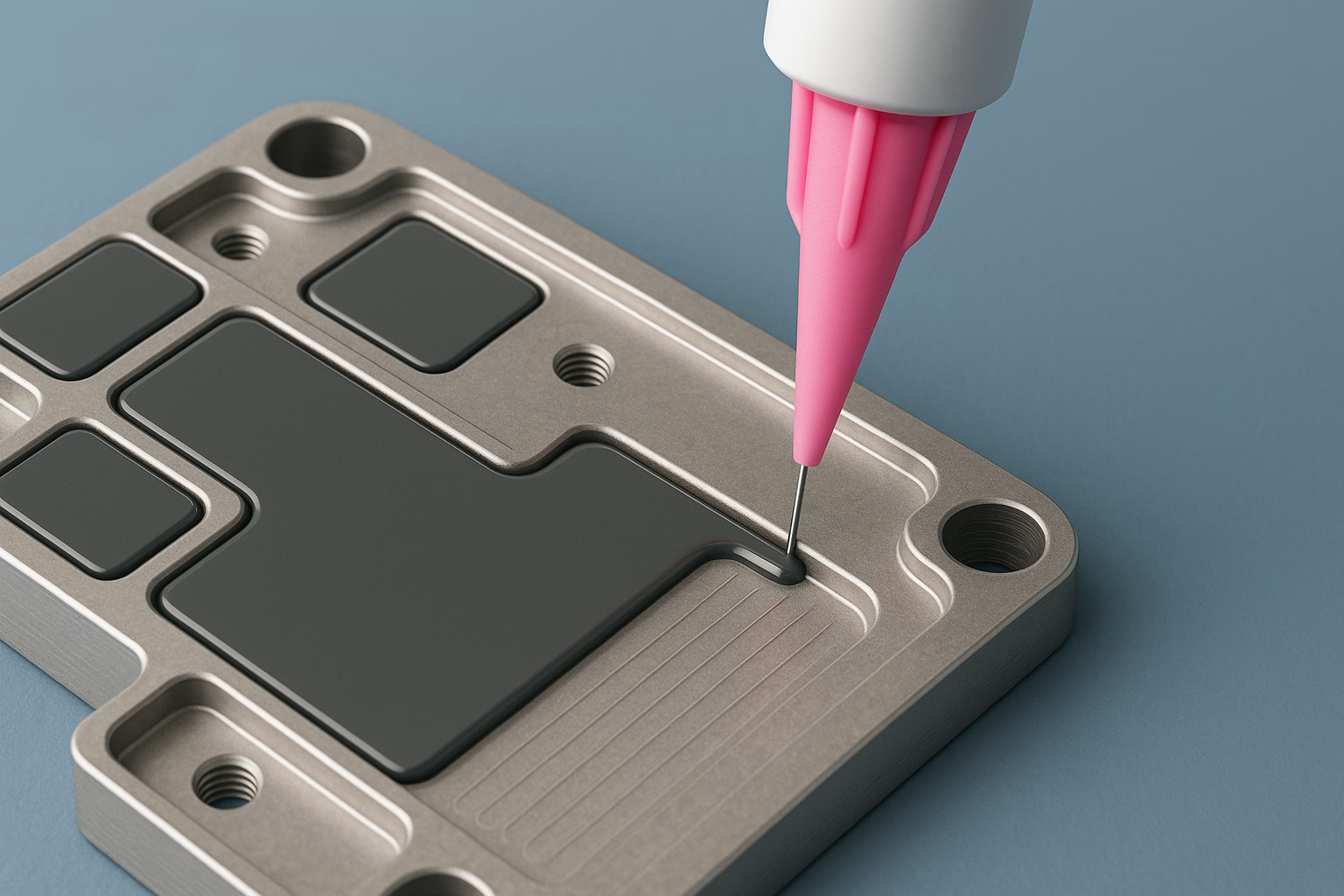
Versatile silicone dispensable alternative to sheet and die-cut RF absorbers
AC-001 Series Overview
Sheet absorbers work for most applications, but not all enclosure geometries are flat rectangles. Compound curves, shielded antenna feeds with internal cavities, automotive radar housings with non-planar geometry, and high-volume production lines that can’t economically apply die-cut sheets all require a different delivery method. Dispensable absorbers solve this by replacing the sheet with a liquid paste: carbonyl iron loaded into a silicone base, dispensed by syringe or automated equipment, then cured in place. Once cured, the material functions identically to a magnetic elastomer sheet through the same loss mechanism. The difference is application, not physics.
The AC-001 Series is most commonly deployed in 24 GHz automotive radar module assembly where automated dispensing replaces manual sheet placement, EV battery housings where complex internal geometry and high-volume production rule out die-cut sheets, RF semiconductor packaging and high-volume RF component assembly, 5G antenna package manufacturing at consumer-electronics volumes, and prototype work where a single material can fill any cavity shape. It is also used to tune existing assemblies where adding sheet material isn’t physically possible after final assembly.
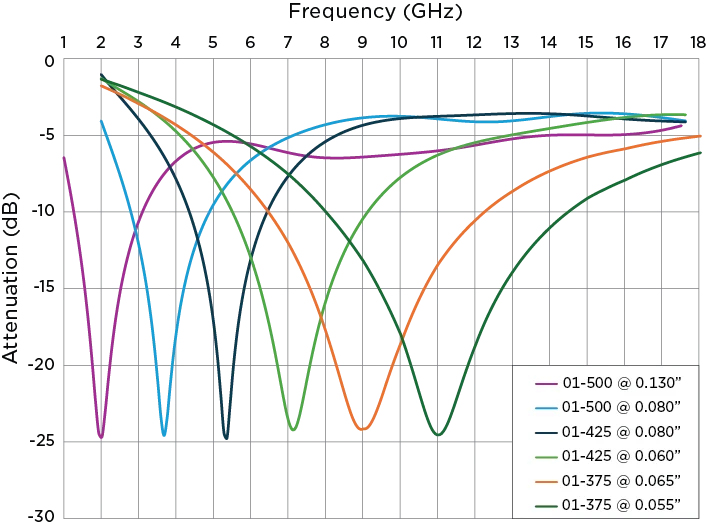
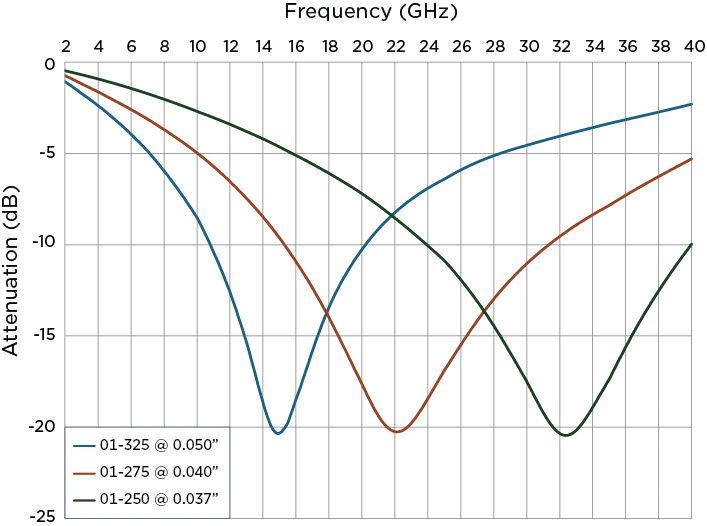
The AC-001 Series covers 1.0 to 40.0 GHz across six standard loading levels, with each loading level optimized for a different region of the band. Viscosity, cure profile, and electrical performance can all be customized to match a specific dispensing process or production constraint. If an automated line needs a particular flow characteristic or the cure cycle needs to match an existing oven schedule, the formulation can be adjusted. 3PB Solutions works with experienced dispensing partners for prototyping through high-volume production.
Electrical Properties
Applications by Product Code
AC-001-01-500 (1.0 – 4.0 GHz)
- RFI suppression in wireless base stations and repeaters
- Cable terminations in large enclosures
- Industrial IoT gateways operating below 4 GHz
- 1.8 GHz – 4G LTE Band 3
- 2.0 GHz – UMTS/WCDMA (3G), S-band satellite
- 2.4 GHz – Wi-Fi (802.11b/g/n), Bluetooth, ISM
- 2.6 GHz – LTE Band 7
AC-001-01-425 (4.0 – 8.0 GHz)
- Cavity absorption in microwave communication equipment
- Suppressing RFI in 5G small cells operating in sub-6 GHz bands
- Reducing interference in backhaul and point-to-point links
- 4.9 GHz – Public safety broadband
- 5.0–5.9 GHz – Wi-Fi 6, ISM, 5G sub-6
- 6.0 GHz – Fixed microwave services
- 7.5 GHz – Broadcast auxiliary services
AC-001-01-375 (8.0 – 12.0 GHz)
- Minimizing interference in X-band satellite communications
- Lining enclosures for high-frequency test equipment
- Reducing coupling in close-proximity high-frequency components
- 8.4 GHz – Deep space communications
- 9.5 GHz – Maritime radar
- 10.5 GHz – Microwave relay links
- 11.5 GHz – Satellite downlinks
AC-001-01-325 (12.0 – 18.0 GHz)
- Reducing interference in Ku-band VSAT terminals
- Absorbing stray emissions in high-frequency radar test setups
- Improving isolation in densely packed RF front-end modules
- 12.5 GHz – Satellite communications
- 14.0 GHz – VSAT uplinks
- 15.5 GHz – Airborne radar
- 17.5 GHz – Fixed satellite services
AC-001-01-275 (18.0 – 27.0 GHz)
- Targeted absorption in K-band communication terminals
- Minimizing crosstalk in millimeter-wave automotive sensors
- Reducing reflections in short-range, high-frequency wireless links
- 18.5 GHz – Satellite uplinks
- 22.0 GHz – Earth observation radar
- 24.0 GHz – Automotive radar
- 26.5 GHz – 5G FR2 mmWave
AC-001-01-250 (27.0 – 40.0 GHz)
- Suppressing interference in Ka-band satellite communications
- Optimizing performance in high-frequency 5G FR2 transceivers
- Reducing internal reflections in precision optical transceiver modules
- 28.0 GHz – 5G FR2 mmWave
- 30.0 GHz – Satellite uplinks
- 35.0 GHz – Military radar
- 38.0 GHz – Fixed wireless access
