CB Series Overview
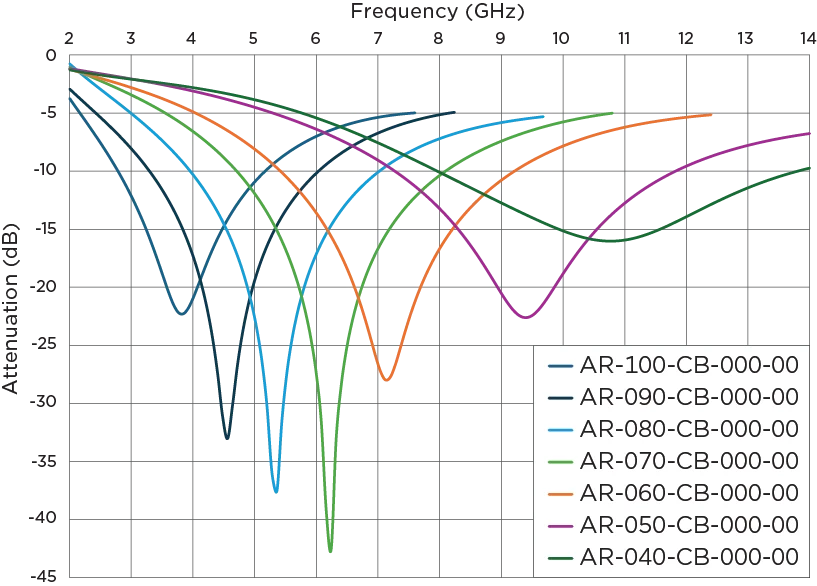
The 4.0 to 8.0 GHz band, known as C-band, is where satellite communications, weather radar, fixed wireless backhaul, and 5 GHz Wi-Fi (including Wi-Fi 6E) share the spectrum. It’s also the resonant frequency band for typical 1.0″ to 1.5″ board-level shield cans, which makes C-band cavity resonance one of the most common EMI failures in dense PCB designs. At these frequencies, wavelength dimensions (37 to 75 mm) make absorber thickness critical: too thin and the material doesn’t intercept enough of the field, too thick and you’ve wasted vertical space in the enclosure. The CB Series uses iron-loaded silicone with a loading level optimized for C-band absorption, delivering higher peak attenuation in the 4 to 8 GHz window than a generic broadband material.
The CB Series is commonly deployed in 5 GHz Wi-Fi access points and Wi-Fi 6E equipment, GNSS and consumer GPS receiver platforms operating in C-band, satellite ground terminals, fixed wireless backhaul links, weather radar systems, and any board-level cavity where 4 to 8 GHz resonance is the EMI failure mode. The 0.050″ thickness is widely deployed in consumer GPS and outdoor recreation electronics where C-band cavity resonance is the dominant EMI failure mode. The CB Series is particularly effective for lining shield can interiors in compact RF assemblies where space efficiency matters as much as absorption depth.
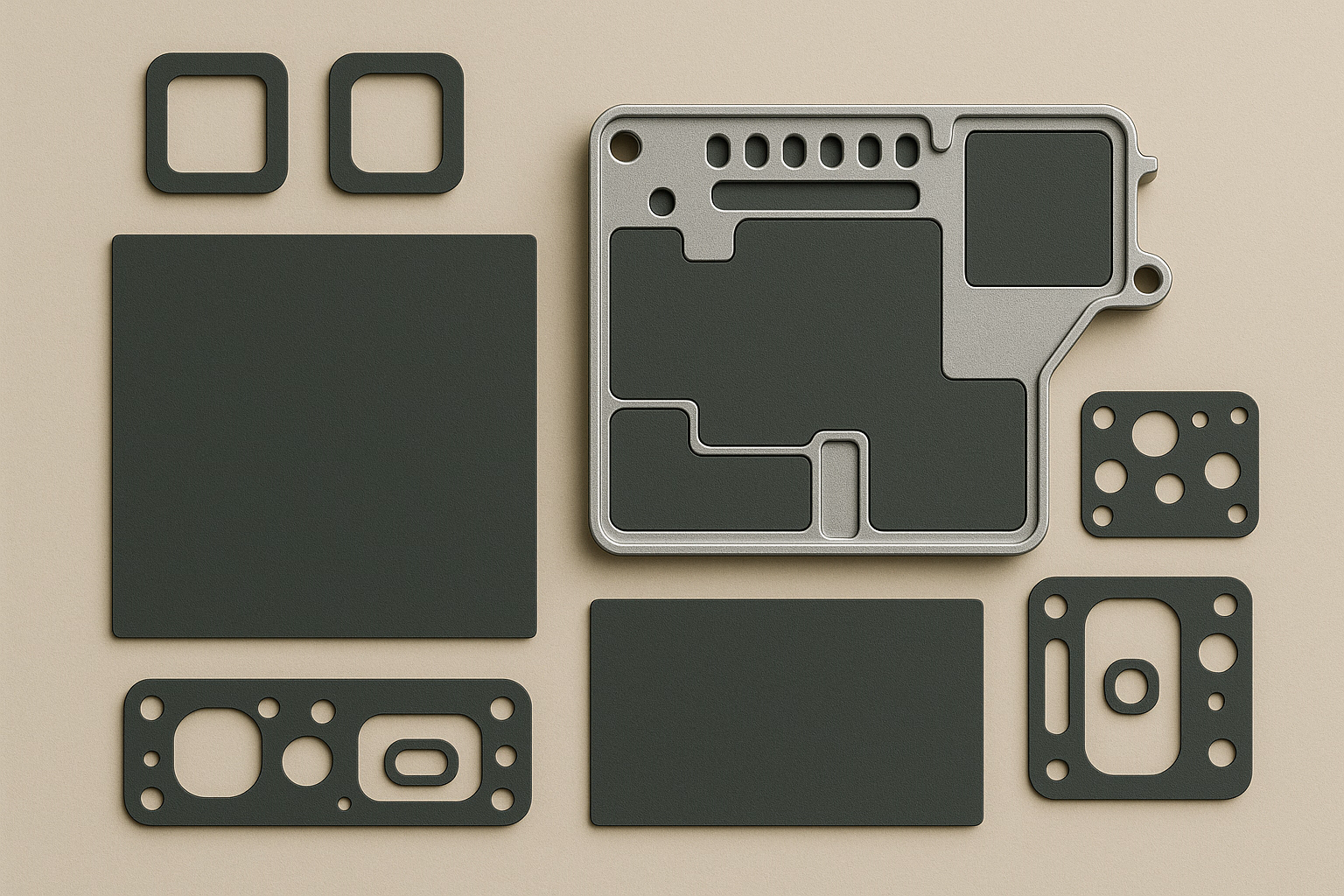
The CB Series is available in seven thicknesses from 0.040″ to 0.100″. The 0.060″ and 0.080″ options hit the sweet spot for most board-level cavity applications, while thicker variants extend performance to the lower edge of the band. The CB Series is a fixed loading level formulation; customization options include thickness selection and in-house die-cutting for direct integration into shield assemblies. Standard PSA backing is available across all thicknesses.
Electrical Properties