KB Series Overview
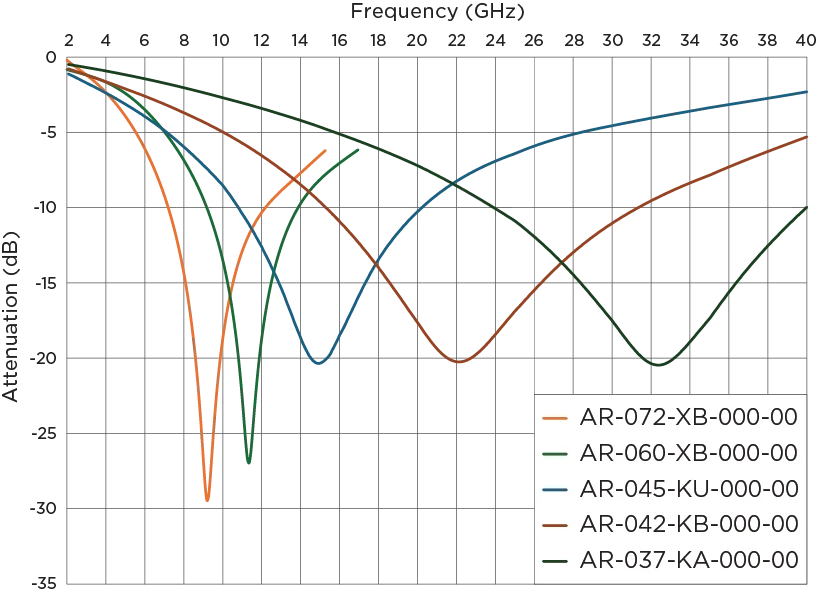
The 18.0 to 27.0 GHz K-band is one of the most challenging frequency ranges for absorber design. Atmospheric water vapor absorption peaks near 22 GHz, which historically limited commercial use of the band, but K-band has become essential for point-to-point microwave links, K-band satellite communications, and emerging 5G FR2 lower-band deployments (n258 at 24 GHz). At wavelengths of 11 to 17 mm, absorber thickness, particle size, and loading uniformity all matter more than they do at lower frequencies. Small variations in formulation produce large changes in performance. The KB Series uses iron-loaded silicone formulated specifically for K-band, with carbonyl iron particle distribution tuned for this wavelength regime.
The KB Series is most commonly deployed in microwave backhaul links operating in K-band, K-band SATCOM ground terminals, 5G FR2 n258 base station equipment at 24 GHz, and test and measurement fixtures for K-band characterization. It is also used in compact radar and electronic warfare systems where K-band coverage is required alongside lower-band performance.
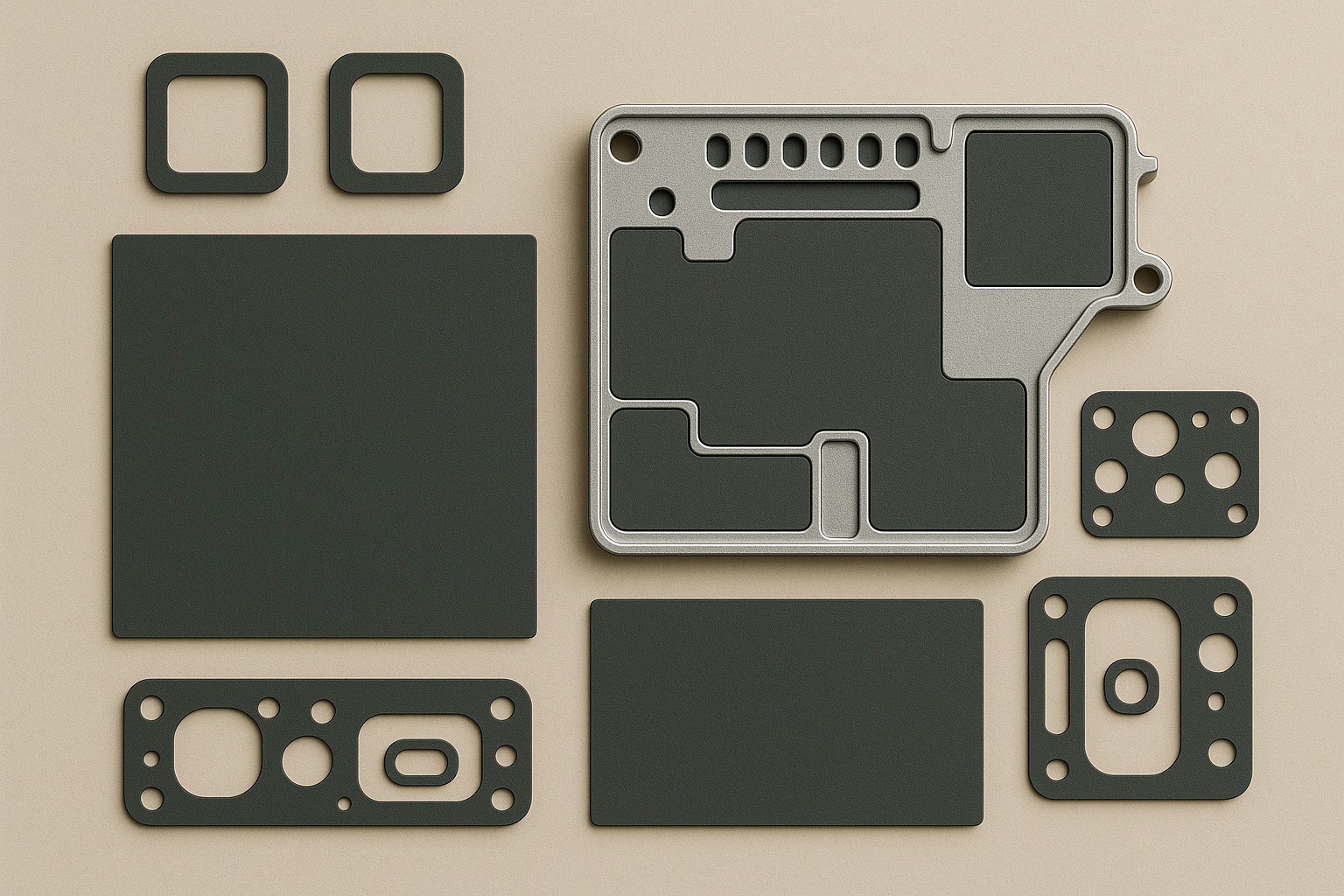
The KB Series is supplied in a single 0.042″ thickness, the optimal depth for K-band absorption given the 11 to 17 mm wavelength range. Generic broadband absorbers leave significant performance on the table at these frequencies because their formulations are tuned for breadth rather than depth. The KB Series is a fixed loading level formulation; customization options include in-house die-cutting for direct integration into microwave backhaul radios, SATCOM modules, and 5G FR2 antenna assemblies. Standard PSA backing is available.
Electrical Properties