
Categories: RF Absorbers

by 3PB Team

Share

Categories: RF Absorbers

by 3PB Team

Share

PIM mitigation RF absorber material installed on cellular antenna for backlobe suppression

Short version: If you’re reading this because your device just failed an emissions test, you’re not alone. It’s one of the most common reasons engineers contact us. In most cases, a thin RF absorber material placed inside the enclosure is enough to get from fail to pass. 3PB Solutions can recommend the right material for your specific failure frequency and ship samples overnight so you’re not burning extra days at the test lab. Request samples now or call (855) 785-5660 and we’ll get you moving immediately.


The Scenario Every Hardware Engineer Recognizes

The device has been through internal testing. Pre-scan results looked clean. Everything passed on the bench. Then you get to the accredited test lab for formal compliance testing, and the scan shows a spike at a specific frequency that puts you 3 to 5 dB over the limit.

Now you’re on the clock. The test lab is booked. Every additional day costs money. The product launch timeline is at risk. And the engineering team needs to find a fix that works without redesigning the PCB or changing the enclosure tooling.

This is the single most common scenario that brings engineers to 3PB Solutions. The fix in most cases is straightforward: place an RF absorber material inside the enclosure to attenuate the energy at the failure frequency. The material absorbs electromagnetic energy that’s resonating inside the cavity or coupling between components, converting it to a small amount of heat. The emission spike drops below the limit. The device passes.

Why Devices Fail at the Test Lab

If the device passed internal pre-screening, the failure at the accredited lab usually comes down to one of two things.

Cavity resonance. The shielded enclosure itself is amplifying emissions at frequencies where the cavity dimensions support standing waves. Pre-screening in an open environment or with the lid off doesn’t catch this because the resonance only exists when the enclosure is sealed. The test lab sees the emission with the product fully assembled, and there’s a spike at a frequency that corresponds to a cavity resonance mode. This is the most common cause of unexpected emissions failures in shielded consumer electronics.

Internal component coupling. Sometimes the device passes emissions testing, but the shielding solution that got it there causes a different problem. A fully shielded enclosure with conductive gasketing contains the emissions effectively, but the reflected energy inside the cavity increases coupling between internal components. The device passes FCC but performance degrades: receiver sensitivity drops, signal-to-noise ratio worsens, or a radio that worked fine on the bench now has desense issues inside its own housing. The shield solved one problem and created another.

Both scenarios have the same fix. An RF absorber placed inside the enclosure dissipates the energy that’s causing the problem instead of reflecting it. For cavity resonance, the absorber dampens the resonant mode. For internal coupling, the absorber reduces the reflected energy that’s bouncing between components.

How to Fix It: The 3PB Solutions Approach

Step 1: Identify the failure frequency

Look at your emissions scan. The spike that’s failing is at a specific frequency. That frequency determines which absorber material gives you the best result. If you have the scan data, send it to us. If you’re at the test lab right now and just need to tell us the frequency and how many dB you need, that’s enough to get started.

Step 2: Start with the US Series

3PB Solutions manufactures RF absorbers covering 0.5 to 100+ GHz. For most emissions failures, the US Series is the first material to try. It’s a thin, lightweight, magnetic-loaded acrylic elastomer designed for 0.5 to 3.0 GHz with useful attenuation extending to 18 GHz. Available in 0.010″, 0.020″, and 0.040″ thicknesses with PSA backing.

The US Series makes sense as a first try for several reasons. It covers a broad frequency range, so it provides useful absorption across many common failure frequencies without needing to precisely match a specific band. It’s thin enough to fit inside enclosures with tight tolerances. It’s non-silicone (acrylic base), which means no outgassing concerns in sensitive applications. And it’s the most cost-effective material in the 3PB Solutions line.

In many cases, the US Series at 0.020″ or 0.040″ placed on the inside of the shield lid is enough to drop a 3 to 5 dB failure below the limit. If you need more attenuation or the failure frequency is well above 3 GHz, step up to a band-specific material.

Step 3: Step up to a narrowband silicone material if needed

If the US Series doesn’t provide enough attenuation at your failure frequency, the next step is a silicone elastomer tuned to the specific band where you’re failing.

The LS Series (1.0 to 4.0 GHz) covers failures in the L and S bands common in Wi-Fi, LTE, and IoT devices. The CB Series (4.0 to 8.0 GHz) and XB Series (8.0 to 12.0 GHz) address the most common cavity resonance range for board-level shields in consumer electronics. The KU Series (12.0 to 18.0 GHz), KB Series (18.0 to 27.0 GHz), and KA Series (27.0 to 40.0 GHz) cover higher frequencies for 5G, radar, and satellite applications.

For failures at a known exact frequency where you need every dB possible, the TF Series (2.0 to 18.0 GHz) provides narrowband materials with formulation and thickness combinations tuned for peak absorption at specific frequencies.

Step 4: Test and verify

Place the absorber material on the inside of the enclosure lid or cavity wall, directly over the area where the resonant energy is concentrated. In most cases, the lid is the best location because it’s easy to access and the tangential magnetic field is at its maximum on the conductive boundary. Re-run the emissions scan at the failure frequency. If the spike drops below the limit, you’re done.

Overnight Samples When You’re at the Test Lab

When an engineer calls from a test lab with a failure, time matters more than anything. Every day at the lab costs money, and the test slot may not be available again for weeks.

3PB Solutions keeps inventory of all standard materials and thicknesses in stock. When you call with a failure frequency and enclosure description, we can recommend 3 to 5 sample materials that cover your frequency range at different thicknesses and ship them overnight. You receive the samples the next morning, apply them in the enclosure, and re-test the same day.

This approach works because you don’t need to find the perfect material on the first try. You need a small selection of candidates that bracket your failure frequency and thickness constraints. Test each one, measure the result, and the scan tells you which material solved the problem. It’s faster and more reliable than trying to predict installed performance from datasheet numbers alone.

Call (855) 785-5660 or email sales@3pbsolutions.com with “EMC Test Failure” in the subject line. Typical response time is under 15 minutes during business hours.

The Proactive Approach: Absorber on Every Lid

Fixing emissions failures at the test lab works, but it happens at the worst possible time in the development cycle. The smarter approach is to design absorber material into the product from the start so the failure never occurs.

The concept is simple: apply a die-cut absorber pad to the inside of every shield lid as part of standard assembly. The material cost per cavity is a few dollars. The labor is a single pick-and-place step. If the absorber prevents even one emissions failure at the test lab, it has paid for itself dozens of times over in avoided test time, engineering hours, and schedule delays.

This approach is becoming standard practice in consumer electronics manufacturing, and for good reason. Modern devices pack more radios, faster processors, and higher clock speeds into smaller enclosures. The probability of hitting a cavity resonance or coupling issue at some frequency is high. Rather than discovering the problem at the test lab and scrambling for a fix, you suppress it from the start.

The US Series is the ideal material for this proactive approach. Its broad frequency coverage handles resonances across a wide range of cavity sizes. Its thin profile (as thin as 0.010″) fits in tight enclosures. Its non-silicone formulation eliminates outgassing concerns. And its low cost makes it practical to apply across every cavity in a multi-shield design without blowing up the BOM.

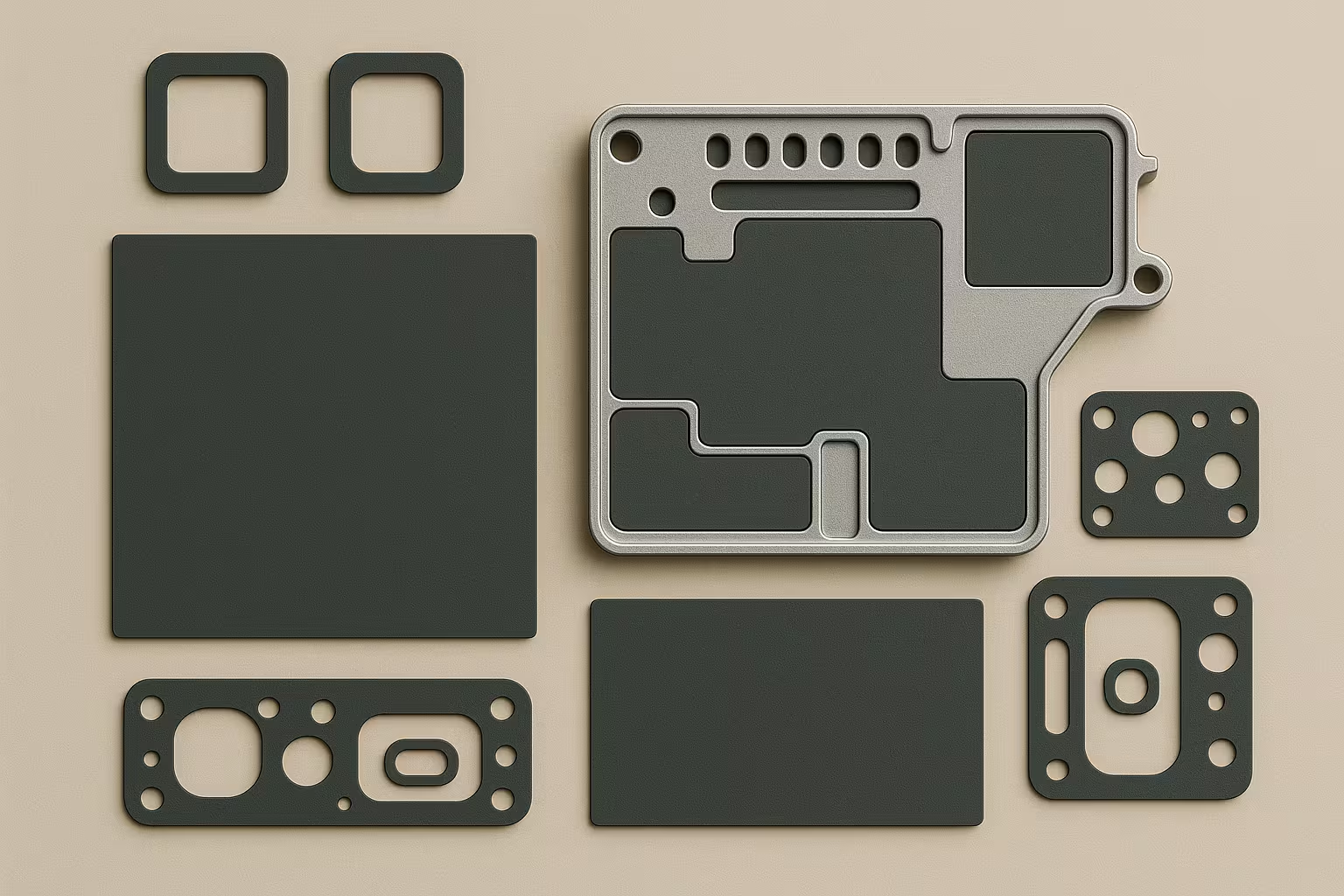
To implement this, send us your shield drawings or cavity dimensions. We’ll recommend material, thickness, and placement for each cavity and provide die-cut parts with PSA backing, ready for your assembly line. Email our engineering team to get started.

RF Absorbers vs. More Shielding

When a device fails emissions, the instinct is often to add more shielding: thicker walls, better gaskets, smaller apertures. Sometimes that’s the right move. But sometimes more shielding makes things worse.

A shielded enclosure is a resonant cavity. At frequencies where the cavity dimensions support standing waves, the shield walls reflect energy back and forth, amplifying internal fields. Making the shield tighter (better gaskets, fewer gaps) increases the Q factor of the cavity, which makes the resonance sharper and more intense. You might suppress the emission that was leaking through a gap, but now the internal coupling is worse and a different problem appears.

RF absorbers solve the problem differently. Instead of reflecting the energy, they dissipate it. The resonant energy gets converted to heat inside the absorber material. The Q factor drops. The standing waves weaken. Internal coupling decreases. And the emission that was leaking out through apertures and seams loses its source energy.

The practical rule of thumb: if your device is failing due to direct radiation through an unshielded area, you need shielding. If your device is failing due to energy that’s building up inside a shielded enclosure, you need absorption. Most production electronics benefit from both: a conductive shield for primary containment, with absorber inside for resonance and coupling control.

What to Expect: Attenuation Numbers

Engineers looking at absorber materials for the first time often want to see -20 dB on a datasheet. That’s 99% absorption, and it looks convincing in a design review. But for most emissions failures, you don’t need -20 dB.

If you’re failing by 3 to 5 dB at a specific frequency, you need 3 to 5 dB of attenuation at that frequency inside your enclosure. That’s a modest amount of absorption, and a single layer of 0.020″ or 0.040″ absorber material frequently provides it. The US Series at 0.040″ is often sufficient for this common failure margin.

Keep in mind that datasheet numbers from NRL arch (free-space) measurements don’t directly translate to installed performance. A material that shows -12 dB on a datasheet might provide -5 dB or -20 dB inside your specific cavity, depending on the geometry, placement, and mode structure. This is why testing in your actual enclosure is the most reliable approach, and why we recommend trying 3 to 5 candidate samples rather than trying to calculate the perfect material from datasheet data alone.

For engineers who want to model performance before physical testing, 3PB Solutions provides complex permeability and permittivity data for all elastomer products. This data can be imported into Ansys HFSS, CST Studio Suite, or COMSOL Multiphysics to simulate absorber performance in your specific enclosure geometry. Email us to request simulation data.

From Fix to Production

Once you’ve identified the material that passes the test, the path to production is straightforward.

1. Confirm the material and thickness. You tested it at the lab. It worked. Note the exact material, thickness, and placement location.

2. Send us your die-cut drawing. We’ll cut the absorber to the exact shape that fits your cavity or shield lid. If you don’t have a drawing, send us the shield dimensions and we’ll create one.

3. Specify PSA backing. Most customers use PSA-backed material for assembly. The adhesive side goes on the shield lid; the absorber faces into the cavity.

4. Order production quantities. Standard lead time is 2 to 3 weeks for die-cut parts, including custom shapes. We maintain lot-to-lot consistency and provide full traceability on all materials.

The material you tested at the lab is the same material that ships in production. No qualification surprises.

Getting Started

If you’re at the test lab right now: Call (855) 785-5660. Tell us the failure frequency, how many dB you need, and the enclosure dimensions. We’ll recommend materials and ship overnight.

If you’re planning ahead: Request a free sample kit with your target frequency range and application details. We’ll send the right materials to evaluate before you get to the lab.

If you want to design absorber in from the start: Email us your shield drawings and we’ll recommend material, thickness, and placement for each cavity.

Quick Contact: Call (855) 785-5660 or email sales@3pbsolutions.com.
Product Finder: Search by frequency, thickness, and base material to find the right part number.

Frequently Asked Questions

My device failed an emissions test. Can an RF absorber fix it?

In most cases, yes. If the failure is caused by cavity resonance or internal coupling inside a shielded enclosure, placing an RF absorber on the inside of the shield lid or cavity wall attenuates the resonant energy and reduces the emission. For failures of 3 to 5 dB over the limit, a single layer of 0.020″ or 0.040″ absorber material is frequently sufficient. Contact 3PB Solutions with your failure frequency and enclosure details, and we can recommend specific materials and ship samples overnight.

How fast can I get RF absorber samples for an EMC test?

3PB Solutions ships overnight in most cases. Call (855) 785-5660 or email with your failure frequency and we’ll recommend 3 to 5 candidate materials and ship them the same day. You can receive samples the next morning and re-test immediately, minimizing time and cost at the lab.

Which RF absorber should I try first for an emissions failure?

Start with the 3PB Solutions US Series. It’s a thin, lightweight, non-silicone (acrylic) absorber covering 0.5 to 18 GHz. Try 0.020″ or 0.040″ thickness on the inside of the shield lid. If the US Series doesn’t provide enough attenuation at your specific failure frequency, step up to a band-specific silicone material tuned to that frequency range: LS (1 to 4 GHz), CB (4 to 8 GHz), XB (8 to 12 GHz), KU (12 to 18 GHz), KB (18 to 27 GHz), or KA (27 to 40 GHz). For exact-frequency tuning, use the TF Series.

Should I add RF absorber to my product proactively?

Yes. The most cost-effective approach is to apply absorber to the inside of every shield lid as part of standard assembly. Modern consumer electronics pack more radios, faster processors, and higher clock speeds into smaller enclosures, making cavity resonance increasingly likely. A die-cut absorber pad costs a few dollars per cavity and prevents emissions failures that cost thousands in test lab time and schedule delays. The US Series is the ideal material for this approach due to its broad frequency coverage, thin profile, and low cost.

What is the difference between shielding and absorbing for EMC?

EMI shields reflect electromagnetic energy using conductive barriers. RF absorbers convert electromagnetic energy into heat using magnetic or dielectric loss materials. Shields are effective for primary containment but can create cavity resonances inside the enclosure that amplify internal fields and increase coupling between components. Absorbers suppress these resonances by dissipating the energy instead of reflecting it. Most production electronics use both: a shield for containment and an absorber inside for resonance and coupling control. If more shielding made the problem worse, absorber material is likely the fix.

PIM mitigation RF absorber material installed on cellular antenna for backlobe suppression

Short version: If you’re reading this because your device just failed an emissions test, you’re not alone. It’s one of the most common reasons engineers contact us. In most cases, a thin RF absorber material placed inside the enclosure is enough to get from fail to pass. 3PB Solutions can recommend the right material for your specific failure frequency and ship samples overnight so you’re not burning extra days at the test lab. Request samples now or call (855) 785-5660 and we’ll get you moving immediately.


The Scenario Every Hardware Engineer Recognizes

The device has been through internal testing. Pre-scan results looked clean. Everything passed on the bench. Then you get to the accredited test lab for formal compliance testing, and the scan shows a spike at a specific frequency that puts you 3 to 5 dB over the limit.

Now you’re on the clock. The test lab is booked. Every additional day costs money. The product launch timeline is at risk. And the engineering team needs to find a fix that works without redesigning the PCB or changing the enclosure tooling.

This is the single most common scenario that brings engineers to 3PB Solutions. The fix in most cases is straightforward: place an RF absorber material inside the enclosure to attenuate the energy at the failure frequency. The material absorbs electromagnetic energy that’s resonating inside the cavity or coupling between components, converting it to a small amount of heat. The emission spike drops below the limit. The device passes.

Why Devices Fail at the Test Lab

If the device passed internal pre-screening, the failure at the accredited lab usually comes down to one of two things.

Cavity resonance. The shielded enclosure itself is amplifying emissions at frequencies where the cavity dimensions support standing waves. Pre-screening in an open environment or with the lid off doesn’t catch this because the resonance only exists when the enclosure is sealed. The test lab sees the emission with the product fully assembled, and there’s a spike at a frequency that corresponds to a cavity resonance mode. This is the most common cause of unexpected emissions failures in shielded consumer electronics.

Internal component coupling. Sometimes the device passes emissions testing, but the shielding solution that got it there causes a different problem. A fully shielded enclosure with conductive gasketing contains the emissions effectively, but the reflected energy inside the cavity increases coupling between internal components. The device passes FCC but performance degrades: receiver sensitivity drops, signal-to-noise ratio worsens, or a radio that worked fine on the bench now has desense issues inside its own housing. The shield solved one problem and created another.

Both scenarios have the same fix. An RF absorber placed inside the enclosure dissipates the energy that’s causing the problem instead of reflecting it. For cavity resonance, the absorber dampens the resonant mode. For internal coupling, the absorber reduces the reflected energy that’s bouncing between components.

How to Fix It: The 3PB Solutions Approach

Step 1: Identify the failure frequency

Look at your emissions scan. The spike that’s failing is at a specific frequency. That frequency determines which absorber material gives you the best result. If you have the scan data, send it to us. If you’re at the test lab right now and just need to tell us the frequency and how many dB you need, that’s enough to get started.

Step 2: Start with the US Series

3PB Solutions manufactures RF absorbers covering 0.5 to 100+ GHz. For most emissions failures, the US Series is the first material to try. It’s a thin, lightweight, magnetic-loaded acrylic elastomer designed for 0.5 to 3.0 GHz with useful attenuation extending to 18 GHz. Available in 0.010″, 0.020″, and 0.040″ thicknesses with PSA backing.

The US Series makes sense as a first try for several reasons. It covers a broad frequency range, so it provides useful absorption across many common failure frequencies without needing to precisely match a specific band. It’s thin enough to fit inside enclosures with tight tolerances. It’s non-silicone (acrylic base), which means no outgassing concerns in sensitive applications. And it’s the most cost-effective material in the 3PB Solutions line.

In many cases, the US Series at 0.020″ or 0.040″ placed on the inside of the shield lid is enough to drop a 3 to 5 dB failure below the limit. If you need more attenuation or the failure frequency is well above 3 GHz, step up to a band-specific material.

Step 3: Step up to a narrowband silicone material if needed

If the US Series doesn’t provide enough attenuation at your failure frequency, the next step is a silicone elastomer tuned to the specific band where you’re failing.

The LS Series (1.0 to 4.0 GHz) covers failures in the L and S bands common in Wi-Fi, LTE, and IoT devices. The CB Series (4.0 to 8.0 GHz) and XB Series (8.0 to 12.0 GHz) address the most common cavity resonance range for board-level shields in consumer electronics. The KU Series (12.0 to 18.0 GHz), KB Series (18.0 to 27.0 GHz), and KA Series (27.0 to 40.0 GHz) cover higher frequencies for 5G, radar, and satellite applications.

For failures at a known exact frequency where you need every dB possible, the TF Series (2.0 to 18.0 GHz) provides narrowband materials with formulation and thickness combinations tuned for peak absorption at specific frequencies.

Step 4: Test and verify

Place the absorber material on the inside of the enclosure lid or cavity wall, directly over the area where the resonant energy is concentrated. In most cases, the lid is the best location because it’s easy to access and the tangential magnetic field is at its maximum on the conductive boundary. Re-run the emissions scan at the failure frequency. If the spike drops below the limit, you’re done.

Overnight Samples When You’re at the Test Lab

When an engineer calls from a test lab with a failure, time matters more than anything. Every day at the lab costs money, and the test slot may not be available again for weeks.

3PB Solutions keeps inventory of all standard materials and thicknesses in stock. When you call with a failure frequency and enclosure description, we can recommend 3 to 5 sample materials that cover your frequency range at different thicknesses and ship them overnight. You receive the samples the next morning, apply them in the enclosure, and re-test the same day.

This approach works because you don’t need to find the perfect material on the first try. You need a small selection of candidates that bracket your failure frequency and thickness constraints. Test each one, measure the result, and the scan tells you which material solved the problem. It’s faster and more reliable than trying to predict installed performance from datasheet numbers alone.

Call (855) 785-5660 or email sales@3pbsolutions.com with “EMC Test Failure” in the subject line. Typical response time is under 15 minutes during business hours.

The Proactive Approach: Absorber on Every Lid

Fixing emissions failures at the test lab works, but it happens at the worst possible time in the development cycle. The smarter approach is to design absorber material into the product from the start so the failure never occurs.

The concept is simple: apply a die-cut absorber pad to the inside of every shield lid as part of standard assembly. The material cost per cavity is a few dollars. The labor is a single pick-and-place step. If the absorber prevents even one emissions failure at the test lab, it has paid for itself dozens of times over in avoided test time, engineering hours, and schedule delays.

This approach is becoming standard practice in consumer electronics manufacturing, and for good reason. Modern devices pack more radios, faster processors, and higher clock speeds into smaller enclosures. The probability of hitting a cavity resonance or coupling issue at some frequency is high. Rather than discovering the problem at the test lab and scrambling for a fix, you suppress it from the start.

The US Series is the ideal material for this proactive approach. Its broad frequency coverage handles resonances across a wide range of cavity sizes. Its thin profile (as thin as 0.010″) fits in tight enclosures. Its non-silicone formulation eliminates outgassing concerns. And its low cost makes it practical to apply across every cavity in a multi-shield design without blowing up the BOM.

To implement this, send us your shield drawings or cavity dimensions. We’ll recommend material, thickness, and placement for each cavity and provide die-cut parts with PSA backing, ready for your assembly line. Email our engineering team to get started.

RF Absorbers vs. More Shielding

When a device fails emissions, the instinct is often to add more shielding: thicker walls, better gaskets, smaller apertures. Sometimes that’s the right move. But sometimes more shielding makes things worse.

A shielded enclosure is a resonant cavity. At frequencies where the cavity dimensions support standing waves, the shield walls reflect energy back and forth, amplifying internal fields. Making the shield tighter (better gaskets, fewer gaps) increases the Q factor of the cavity, which makes the resonance sharper and more intense. You might suppress the emission that was leaking through a gap, but now the internal coupling is worse and a different problem appears.

RF absorbers solve the problem differently. Instead of reflecting the energy, they dissipate it. The resonant energy gets converted to heat inside the absorber material. The Q factor drops. The standing waves weaken. Internal coupling decreases. And the emission that was leaking out through apertures and seams loses its source energy.

The practical rule of thumb: if your device is failing due to direct radiation through an unshielded area, you need shielding. If your device is failing due to energy that’s building up inside a shielded enclosure, you need absorption. Most production electronics benefit from both: a conductive shield for primary containment, with absorber inside for resonance and coupling control.

What to Expect: Attenuation Numbers

Engineers looking at absorber materials for the first time often want to see -20 dB on a datasheet. That’s 99% absorption, and it looks convincing in a design review. But for most emissions failures, you don’t need -20 dB.

If you’re failing by 3 to 5 dB at a specific frequency, you need 3 to 5 dB of attenuation at that frequency inside your enclosure. That’s a modest amount of absorption, and a single layer of 0.020″ or 0.040″ absorber material frequently provides it. The US Series at 0.040″ is often sufficient for this common failure margin.

Keep in mind that datasheet numbers from NRL arch (free-space) measurements don’t directly translate to installed performance. A material that shows -12 dB on a datasheet might provide -5 dB or -20 dB inside your specific cavity, depending on the geometry, placement, and mode structure. This is why testing in your actual enclosure is the most reliable approach, and why we recommend trying 3 to 5 candidate samples rather than trying to calculate the perfect material from datasheet data alone.

For engineers who want to model performance before physical testing, 3PB Solutions provides complex permeability and permittivity data for all elastomer products. This data can be imported into Ansys HFSS, CST Studio Suite, or COMSOL Multiphysics to simulate absorber performance in your specific enclosure geometry. Email us to request simulation data.

From Fix to Production

Once you’ve identified the material that passes the test, the path to production is straightforward.

1. Confirm the material and thickness. You tested it at the lab. It worked. Note the exact material, thickness, and placement location.

2. Send us your die-cut drawing. We’ll cut the absorber to the exact shape that fits your cavity or shield lid. If you don’t have a drawing, send us the shield dimensions and we’ll create one.

3. Specify PSA backing. Most customers use PSA-backed material for assembly. The adhesive side goes on the shield lid; the absorber faces into the cavity.

4. Order production quantities. Standard lead time is 2 to 3 weeks for die-cut parts, including custom shapes. We maintain lot-to-lot consistency and provide full traceability on all materials.

The material you tested at the lab is the same material that ships in production. No qualification surprises.

Getting Started

If you’re at the test lab right now: Call (855) 785-5660. Tell us the failure frequency, how many dB you need, and the enclosure dimensions. We’ll recommend materials and ship overnight.

If you’re planning ahead: Request a free sample kit with your target frequency range and application details. We’ll send the right materials to evaluate before you get to the lab.

If you want to design absorber in from the start: Email us your shield drawings and we’ll recommend material, thickness, and placement for each cavity.

Quick Contact: Call (855) 785-5660 or email sales@3pbsolutions.com.
Product Finder: Search by frequency, thickness, and base material to find the right part number.

Frequently Asked Questions

My device failed an emissions test. Can an RF absorber fix it?

In most cases, yes. If the failure is caused by cavity resonance or internal coupling inside a shielded enclosure, placing an RF absorber on the inside of the shield lid or cavity wall attenuates the resonant energy and reduces the emission. For failures of 3 to 5 dB over the limit, a single layer of 0.020″ or 0.040″ absorber material is frequently sufficient. Contact 3PB Solutions with your failure frequency and enclosure details, and we can recommend specific materials and ship samples overnight.

How fast can I get RF absorber samples for an EMC test?

3PB Solutions ships overnight in most cases. Call (855) 785-5660 or email with your failure frequency and we’ll recommend 3 to 5 candidate materials and ship them the same day. You can receive samples the next morning and re-test immediately, minimizing time and cost at the lab.

Which RF absorber should I try first for an emissions failure?

Start with the 3PB Solutions US Series. It’s a thin, lightweight, non-silicone (acrylic) absorber covering 0.5 to 18 GHz. Try 0.020″ or 0.040″ thickness on the inside of the shield lid. If the US Series doesn’t provide enough attenuation at your specific failure frequency, step up to a band-specific silicone material tuned to that frequency range: LS (1 to 4 GHz), CB (4 to 8 GHz), XB (8 to 12 GHz), KU (12 to 18 GHz), KB (18 to 27 GHz), or KA (27 to 40 GHz). For exact-frequency tuning, use the TF Series.

Should I add RF absorber to my product proactively?

Yes. The most cost-effective approach is to apply absorber to the inside of every shield lid as part of standard assembly. Modern consumer electronics pack more radios, faster processors, and higher clock speeds into smaller enclosures, making cavity resonance increasingly likely. A die-cut absorber pad costs a few dollars per cavity and prevents emissions failures that cost thousands in test lab time and schedule delays. The US Series is the ideal material for this approach due to its broad frequency coverage, thin profile, and low cost.

What is the difference between shielding and absorbing for EMC?

EMI shields reflect electromagnetic energy using conductive barriers. RF absorbers convert electromagnetic energy into heat using magnetic or dielectric loss materials. Shields are effective for primary containment but can create cavity resonances inside the enclosure that amplify internal fields and increase coupling between components. Absorbers suppress these resonances by dissipating the energy instead of reflecting it. Most production electronics use both: a shield for containment and an absorber inside for resonance and coupling control. If more shielding made the problem worse, absorber material is likely the fix.