
by 3PB Team
Short version: 5G FR2 and Ka-band satellite systems operate at frequencies from 18 GHz to 40 GHz and above, where RF absorber material selection gets more demanding. The wavelengths are shorter, the cavity dimensions are smaller, and the absorber materials need to be thinner and precisely tuned. 3PB Solutions manufactures elastomer sheet absorbers and foam absorbers covering the full mmWave range from 18 GHz to 100+ GHz, plus weatherproof PIM mitigation panels deployed at scale on 5G antenna installations. Keep reading for the full breakdown of which RF absorbers work at mmWave frequencies and why.
Need extra help? Contact our engineering team for a rapid response.
Why mmWave Frequencies Change the Absorber Equation
At sub-6 GHz frequencies (5G FR1, Wi-Fi, LTE), RF absorber material selection is relatively forgiving. The wavelengths are long enough that a broadband material like the US Series or LS Series can cover a wide range of applications with a single formulation and thickness.
At mmWave frequencies (generally above 18 GHz), three things change.
Wavelengths get short. At 28 GHz, the free-space wavelength is about 10.7 mm. At 39 GHz, it’s about 7.7 mm. This means the absorber material, the cavity geometry, and the placement all interact at a finer scale. Small changes in material thickness or position have a larger effect on performance. The margin for error shrinks.
Cavities get smaller. The enclosures housing mmWave electronics are compact. A 5G FR2 antenna module, a Ka-band satellite transponder, or an automotive radar sensor doesn’t have room for a thick absorber pad. The material needs to be thin and lightweight while still providing meaningful absorption at the target frequency.
Magnetic loss materials thin out naturally. The iron-loaded elastomer absorbers that work at lower frequencies also work at mmWave frequencies, but they need to be thinner. Higher frequencies require less material depth to achieve effective absorption because the wavelength is shorter relative to the material thickness. This is why the 3PB Solutions silicone series gets progressively thinner as the frequency range increases: the LS Series at 1 to 4 GHz comes in thicknesses up to 0.125″, while the KA Series at 27 to 40 GHz is just 0.037″ thick.
5G Frequency Bands and Absorber Requirements
The 5G NR standard defines two frequency ranges. Each has different absorber material requirements.
5G FR1 (sub-6 GHz). This includes bands from 410 MHz to 7.125 GHz. FR1 covers the widely deployed bands like n77 (3.3 to 4.2 GHz), n78 (3.3 to 3.8 GHz), and n79 (4.4 to 5.0 GHz). These frequencies fall squarely in the range of standard magnetically loaded elastomer absorbers. The CB Series (4.0 to 8.0 GHz) and LS Series (1.0 to 4.0 GHz) cover FR1 applications. The US Series (0.5 to 3.0 GHz, fielded to 18 GHz) also provides useful absorption across much of the FR1 range.
5G FR2 (mmWave). This is where the higher-frequency absorber materials come in. The key FR2 bands are:
n257 at 28 GHz (26.50 to 29.50 GHz): Falls within the KB Series (18.0 to 27.0 GHz) and KA Series (27.0 to 40.0 GHz) ranges. The 28 GHz band sits right at the boundary between these two series, so either material can be effective depending on the specific frequency and attenuation requirement.
n258 at 26 GHz (24.25 to 27.50 GHz): Covered by the KB Series.
n260 at 39 GHz (37.00 to 40.00 GHz): Covered by the KA Series.
n261 at 28 GHz (27.50 to 28.35 GHz): Covered by the KA Series.
Elastomer Sheet Absorbers for mmWave
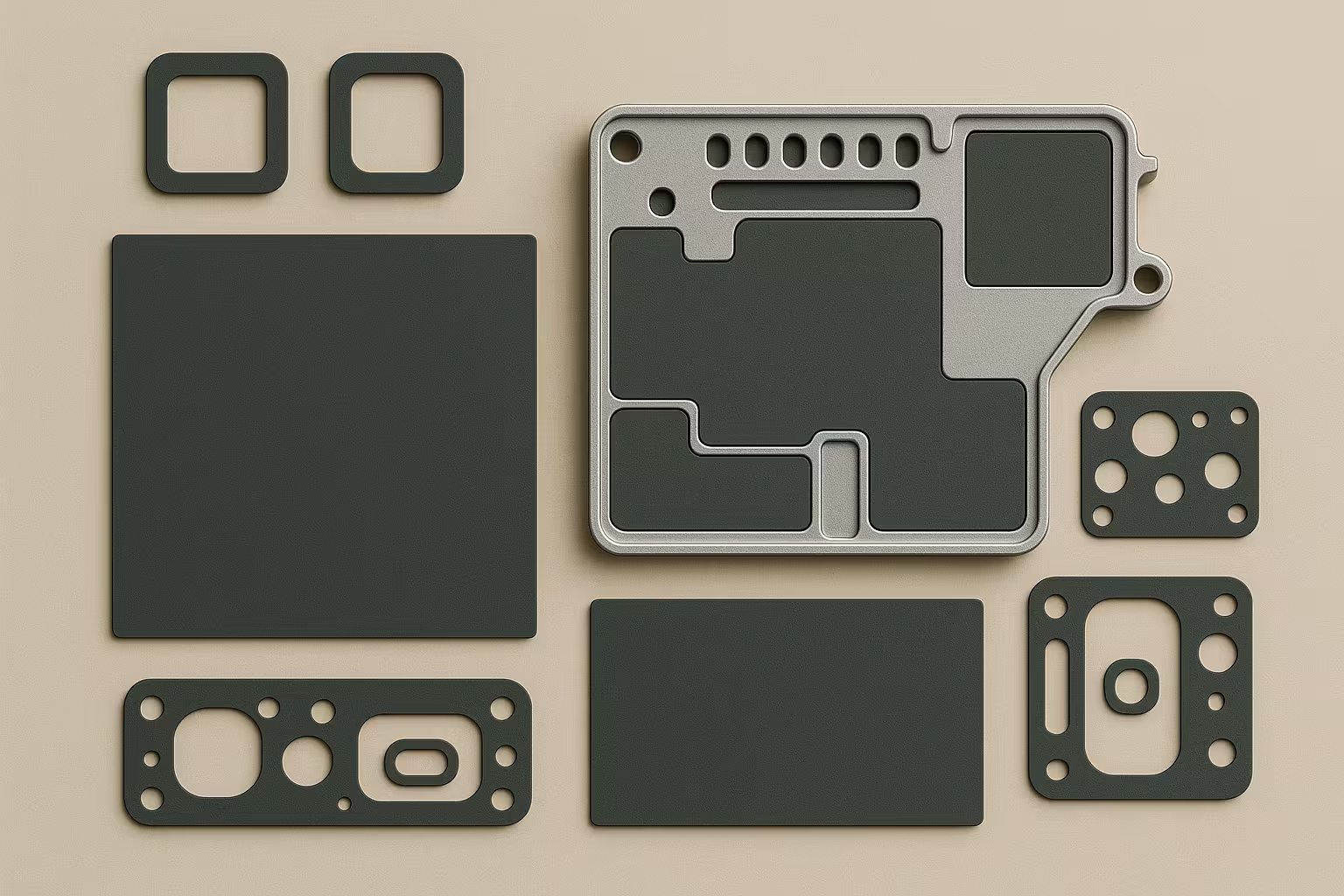
Thin, flexible, magnetically loaded elastomer sheets are the primary absorber type for mmWave applications inside electronic enclosures. They suppress cavity resonance, reduce component-to-component coupling, and attenuate surface currents at mmWave frequencies just as they do at lower frequencies, but in a thinner form factor.
Published performance data for every series discussed here is available on our RF absorber materials page.
KU Series (12.0 to 18.0 GHz)
The KU Series covers the transition between traditional microwave and mmWave frequencies. At 0.045″ thick, it addresses Ku-band satellite communications, VSAT terminals, and the lower end of 5G backhaul systems operating in the 12 to 18 GHz range. Also used in test and measurement equipment enclosures operating at these frequencies.
KB Series (18.0 to 27.0 GHz)
The KB Series is an iron-loaded silicone elastomer at 0.042″ thick, optimized for the K and lower Ka bands. This is the primary material for 5G n258 (26 GHz) applications, K-band satellite systems, and point-to-point backhaul links operating in the 18 to 27 GHz range. Available in standard sheet sizes with PSA backing and custom die-cutting.
KA Series (27.0 to 40.0 GHz)
The KA Series is the thinnest elastomer absorber in the 3PB Solutions line at 0.037″ thick. It covers the upper Ka band and the primary 5G FR2 bands: n257 (28 GHz), n260 (39 GHz), and n261 (28 GHz). Also specified in Ka-band satellite transponders, automotive radar sensor housings (24 GHz and 77 GHz proximity), and precision mmWave test equipment.
Both the KB and KA Series are iron-loaded silicone elastomers. They’re flexible, available with PSA backing, and can be die-cut to any 2D geometry. RoHS/REACH compliant with operating temperature rated for the full range of commercial and industrial environments.
Foam Absorbers for mmWave
For free-space mmWave applications where the absorber isn’t placed inside an enclosure but rather in the signal path between systems, carbon-loaded foam absorbers provide broadband coverage well into the mmWave range.
The AF Series Reticulated Foam is serviceable up to and above 100 GHz, making it effective for 5G FR2, automotive radar at 77 GHz, and emerging applications at W-band (75 to 110 GHz) and beyond. The tapered carbon loading and impedance-matched front face provide low reflection when installed on a conductive backing. Available from 0.375″ to 1.250″ thick, with thinner material covering higher frequencies. 3PB Solutions can supply reticulated foam with a conductive foil backing pre-installed.
The AF Series Lossy Foam covers 1 to 40 GHz for free-space isolation applications. It does not require a conductive backing and is used for signal isolation between mmWave antenna elements, lining compact test enclosures, and reducing back lobes in antenna assemblies. Can be machined to 3D geometries from CAD files for custom mmWave fixture applications.
PIM Mitigation at 5G Frequencies
Passive intermodulation (PIM) is one of the biggest field performance issues facing wireless carriers as they deploy 5G alongside existing 3G and 4G/LTE systems. When RF signals from multiple carriers mix at non-linear junctions near the antenna (corroded connectors, rusty hardware, metal-to-metal contacts on tower structures), they generate intermodulation products that can fall into 5G receive bands and degrade network performance.
The problem gets worse as carriers add more bands to existing tower sites. Every new band creates more potential intermodulation products. And because 5G NR uses wider channel bandwidths than previous generations, the receivers are more sensitive to PIM interference.
The PM Series PIM Mitigation Materials are weatherproof RF absorber foam panels that install around antenna mounting hardware and nearby metallic surfaces to absorb the scattered and reflected energy that drives PIM. The foam is wrapped in Herculite fabric meeting MIL-PRF-20696F Type 2 Class 2, making it waterproof, UV-resistant, flame-retardant, and tear-resistant for outdoor tower installations.
PM Series panels cover 0.5 to 40 GHz, which means a single installation addresses PIM across all carrier bands from low-band LTE through mmWave 5G. Available in thicknesses from 0.500″ to 2.000″ with custom kit configurations designed to fit around specific antenna mounting hardware. Installation uses PSA backing with velcro straps for wind load security. Major wireless carriers are currently deploying these materials at scale on 3G, 4G/LTE, and 5G macro cell and small cell installations.
Selecting the Right Material for Your mmWave Application
Inside a 5G radio enclosure or antenna module: Start with the KA Series (27 to 40 GHz) or KB Series (18 to 27 GHz) depending on your operating frequency. These thin elastomer sheets fit inside compact mmWave housings and suppress cavity resonance at the frequencies where these small cavities naturally resonate. Apply with PSA backing to the inside of the shield lid or enclosure wall.
Between mmWave antenna elements or in a test fixture: Use AF Series Reticulated Foam on a conductive backing for low-reflection absorption, or AF Series Lossy Foam for through-material attenuation without a backing requirement. Both cover the mmWave range with broadband performance.
On a 5G antenna tower or rooftop installation: PM Series PIM Mitigation panels. These are the only weatherproof RF absorber foam panels purpose-built for outdoor antenna installations, covering all carrier bands from 0.5 to 40 GHz in a single material.
Not sure which frequency band you’re targeting: If your application spans both sub-6 GHz and mmWave frequencies, or if you’re not certain where the problem frequency is, contact our engineering team with your application details. We’ll recommend the right starting point and can ship multiple candidate materials overnight if you’re troubleshooting at the test lab.
Complex Permeability and Permittivity Data for EM Simulation
Engineers designing mmWave systems frequently use electromagnetic simulation tools (Ansys HFSS, CST Studio Suite, COMSOL Multiphysics) to model absorber performance before committing to physical prototypes. At mmWave frequencies, simulation is especially valuable because small changes in material placement and thickness have a larger effect on performance than at lower frequencies.
3PB Solutions provides complex permeability and permittivity data for all elastomer absorber products, including the KB and KA Series. This data can be imported directly into your simulation tool to model how the absorber will perform in your specific cavity geometry, antenna housing, or test fixture. Email our engineering team to request simulation data for any material in the 3PB Solutions line.
Getting Started
The fastest way to evaluate mmWave absorber materials is to request a free sample kit. Tell us your operating frequency, application type, and enclosure dimensions. We’ll send the right materials for your evaluation.
For PIM mitigation projects on 5G antenna installations, email us with your antenna configuration and we’ll design a custom kit.
Quick Contact: Call (855) 785-5660 or email sales@3pbsolutions.com.
Product Finder: Search by frequency, thickness, and base material to find the right part number.
Frequently Asked Questions
For 5G FR2 frequencies (24 to 40 GHz), magnetically loaded elastomer sheet absorbers are the standard solution for cavity resonance and EMI suppression inside enclosures. The 3PB Solutions KB Series (18 to 27 GHz, 0.042″ thick) and KA Series (27 to 40 GHz, 0.037″ thick) are iron-loaded silicone elastomers designed for these frequency ranges. For free-space mmWave applications, the AF Series Reticulated Foam is serviceable above 100 GHz. For outdoor antenna PIM mitigation across all 5G bands, the PM Series weatherproof foam panels cover 0.5 to 40 GHz.
5G FR1 (sub-6 GHz, up to 7.125 GHz) uses the same absorber materials as Wi-Fi and LTE applications: the US Series, LS Series, and CB Series cover this range with standard thicknesses. 5G FR2 (mmWave, 24.25 to 52.6 GHz) requires thinner, higher-frequency absorber materials like the KB Series and KA Series. The key difference is that mmWave absorbers are thinner by design because shorter wavelengths require less material depth for effective absorption.
Install weatherproof RF absorber foam panels around antenna mounting hardware and nearby metallic surfaces that act as PIM sources. The 3PB Solutions PM Series PIM Mitigation Materials are fabric-wrapped foam panels covering 0.5 to 40 GHz, designed specifically for outdoor tower and rooftop installations. Panels are available in custom kit configurations sized to fit around specific antenna mounting hardware, with PSA backing and velcro straps for secure installation. Major wireless carriers are deploying these materials at scale on 3G, 4G/LTE, and 5G installations.
Yes. 3PB Solutions provides complex permeability and permittivity data for all elastomer absorber products including the KB and KA Series. This data imports directly into electromagnetic simulation tools like Ansys HFSS, CST Studio Suite, and COMSOL Multiphysics. Email our engineering team to request data for any material in the product line.
Automotive radar operates at 77 GHz, which is above the range of the elastomer sheet absorber series (which top out at 40 GHz). For 77 GHz applications, the AF Series Reticulated Foam (serviceable above 100 GHz) is the appropriate material. For cavity resonance inside automotive radar module housings at lower frequencies, the KA Series elastomer sheet can address resonances in the 27 to 40 GHz range. Contact us with your specific radar module requirements and we’ll recommend the right combination of materials.
