
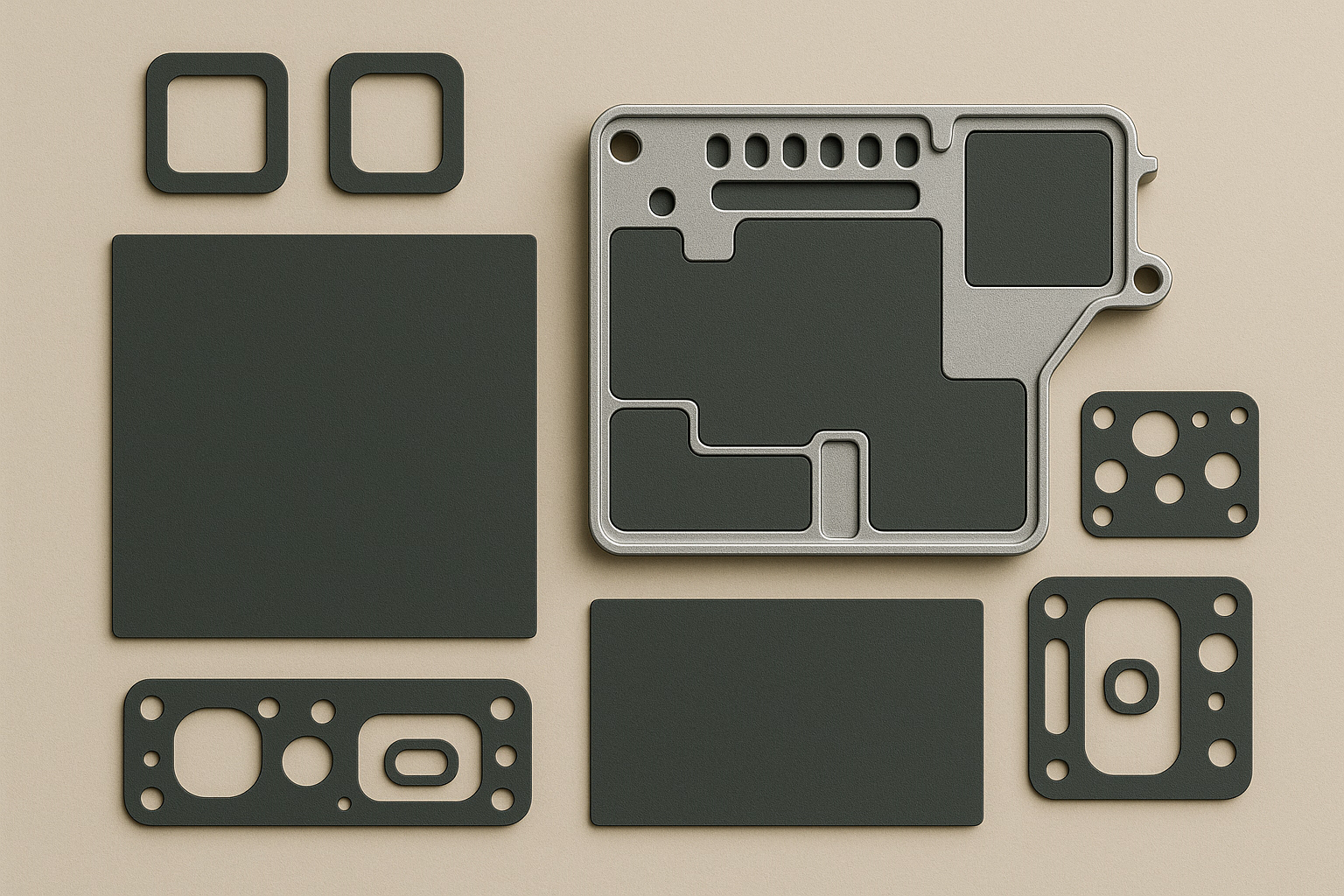
KA Series Overview
The 27.0 to 40.0 GHz Ka-band is the front line of millimeter-wave electronics. 5G FR2 mmWave (28 GHz n257/n261, 39 GHz n260), Ka-band satellite communications, and high-speed optical transceiver clock circuits all operate here. At these frequencies, wavelengths shrink to 7.5 to 11 mm, meaning standard absorber thicknesses designed for lower bands can actually create more problems than they solve, introducing reflections rather than attenuating the field. Ka-band absorption requires thinner materials with higher magnetic loading, plus careful attention to particle size distribution to avoid scattering losses. The KA Series uses iron-loaded silicone formulated specifically for the mmWave regime.
The KA Series is commonly deployed in 5G FR2 mmWave modules operating at 28 GHz and 39 GHz, Ka-band satellite ground terminals and user equipment (including consumer broadband satellite internet platforms), and high-speed optical transceiver assemblies handling 25G/100G+ PAM4 signaling. The optical interconnect application is significant: at modern PAM4 signaling rates, harmonic content extends well into the Ka-band, and 0.037″ KA Series material is widely deployed in optical transceiver enclosures to suppress this content before it couples into adjacent components or escapes the package. It is also used in compact mmWave antenna packages where component density makes coupling control critical.
The KA Series is supplied in a single 0.037″ thickness, the thinnest in the magnetic elastomer lineup, sized for the 7.5 to 11 mm wavelength range where thicker materials produce reflections rather than absorption. The KA Series is a fixed loading level formulation; customization options include in-house die-cutting for direct integration into 5G FR2 modules, optical transceiver enclosures, and mmWave antenna assemblies. Standard PSA backing is available. Engineers working in this band should expect the physics to differ substantially from sub-6 GHz design experience. The KA Series is built for that difference.
