
by 3PB Team
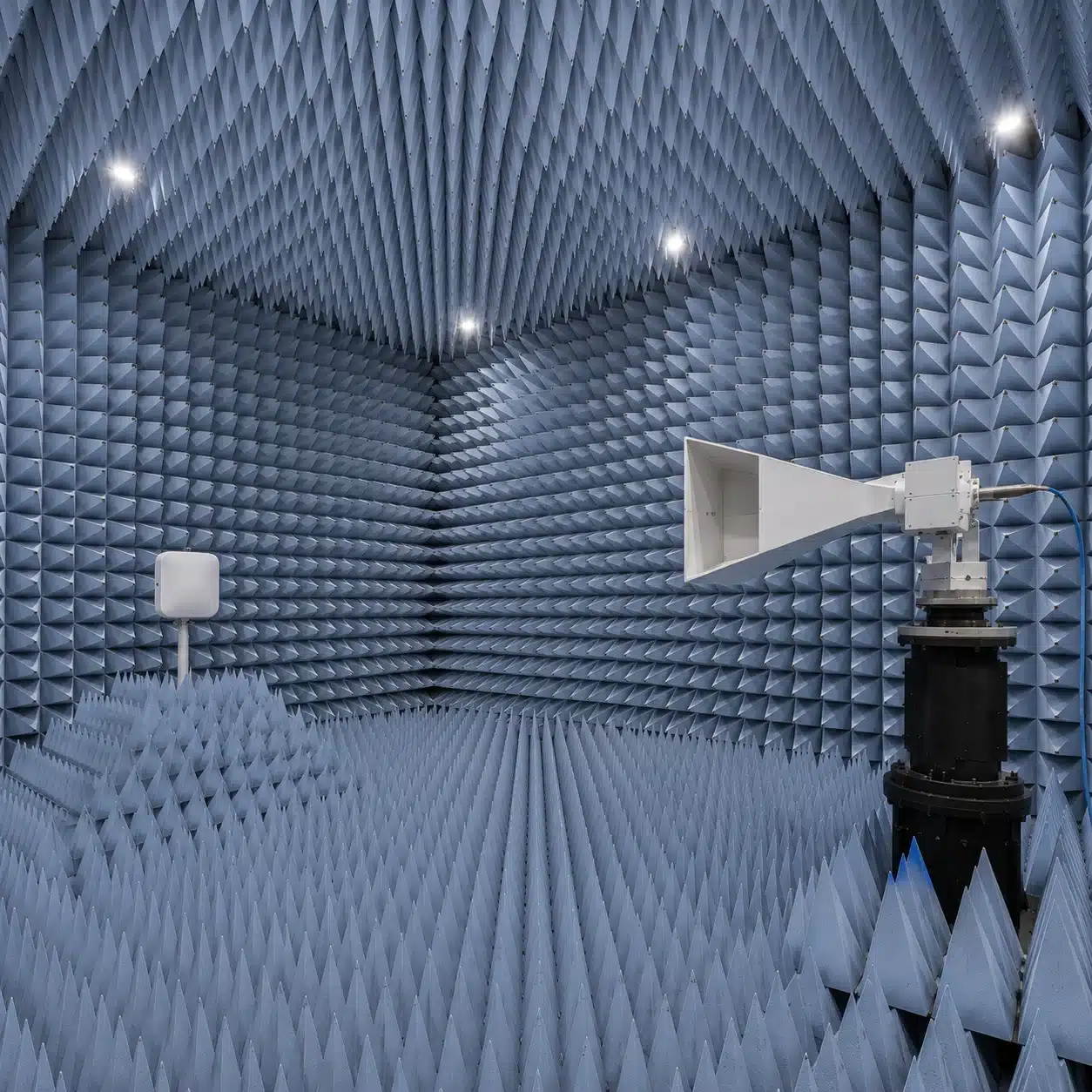
Short version: If you are building, upgrading, or repairing an anechoic chamber, the absorber material determines the chamber’s performance envelope. Pyramidal foam, ferrite tile, hybrid absorbers, and flat reticulated foam each serve different roles depending on frequency range, chamber geometry, and test application. 3PB Solutions manufactures reticulated foam and broadband lossy foam for chamber and test fixture applications, available online in standard sheets, and can source pyramidal and ferrite materials for complete chamber solutions. Request a free sample kit or keep reading for the full selection guide.
Need extra help? Contact our engineering team for a rapid response.
Why Chamber Absorber Selection Matters
An anechoic chamber is only as good as its absorber treatment. The chamber itself is a shielded room, a metal box that isolates the test environment from external interference. The absorber material transforms that metal box into a simulated free-space environment by preventing reflections from the walls, ceiling, and floor.
The reflectivity performance of the absorber treatment directly determines quiet zone quality. A chamber achieving -40 dB reflectivity has a fundamentally different measurement capability than one at -20 dB. The difference between those two numbers is the difference between an antenna measurement that matches simulation and one that does not.
Absorber Types for Chamber Applications
Pyramidal foam absorbers are the most recognizable type: carbon-loaded polyurethane pyramids lining the walls of most RF anechoic chambers. The pyramidal shape creates a gradual impedance transition from free space into the lossy material, minimizing reflection at the air-absorber interface. Taller pyramids reach lower frequencies because the transition region is a larger fraction of the wavelength: a 36-inch pyramid provides useful absorption down to roughly 100 MHz, while a 6-inch pyramid is effective from about 500 MHz up.
Ferrite tile absorbers are thin ceramic tiles, typically 6 mm thick, absorbing from roughly 30 MHz to 1 GHz through magnetic loss. They are the standard solution for the low-frequency end of EMC compliance testing, used alone in chambers covering only the FCC/CISPR emissions range or under foam in broadband chambers.
Hybrid absorbers combine a ferrite tile base with a shorter foam pyramid on top: ferrite handles the low end, foam handles the high end, delivering 30 MHz to 18+ GHz in a shorter profile than pyramids alone. This is the standard approach for modern EMC compliance chambers.
Flat reticulated foam absorbers achieve the same impedance-transition principle as pyramids electrically instead of geometrically: the carbon loading is graded from light at the front face to heavy at the back, inside a flat sheet 0.375″ to 1.250″ thick. Where a pyramid needs geometry measured in feet, reticulated foam delivers -20 to -40 dB from 4 GHz to above 100 GHz in about an inch, installed on a conductive surface.
Flat Foam or Pyramids? A Practical Rule
For full-size chambers qualifying below 4 GHz, pyramidal (or hybrid) treatment remains the right answer; nothing flat matches pyramid performance at the bottom of the band. Above 4 GHz, the calculus changes. OTA test boxes, benchtop enclosures, millimeter-wave measurement setups, positioner and fixture treatment, and chamber retrofits where pyramids will not fit are all better served by flat reticulated foam: comparable reflectivity in a fraction of the depth, simpler installation, and standard sheets that ship in 2 to 3 weeks from stock sizes rather than being quoted per project. For mixed installations, many facilities line the critical reflection zones with pyramids and treat fixtures, corners, and equipment surfaces with flat foam.
When to Replace Chamber Absorbers
Polyurethane foam absorbers degrade. Carbon loading shifts, foam structure breaks down, and fire-retardant treatments lose effectiveness. Most chamber manufacturers recommend a 15- to 20-year absorber lifespan, but humidity, temperature extremes, and UV exposure can shorten it significantly.
Signs that replacement is due: visible degradation (crumbling, discoloration, sagging), failed chamber qualification measurements showing increased reflectivity, and test results that no longer correlate with simulation or historical data. If your chamber was last qualified five or more years ago and you are seeing measurement anomalies, absorber degradation is the first suspect.
Fire Safety and Flammability Ratings
Chamber absorbers are installed in enclosed spaces where fire safety is a real concern. The industry standard for anechoic chamber foam is NRL 8000 (I, II, or III), a fire-retardancy specification established by the Naval Research Laboratory covering burn rate, smoke generation, and self-extinguishing behavior. Commercial EMC facilities typically specify UL 94 HF-1 or equivalent; military and defense chambers often require halogen-free, low-smoke formulations. Confirm the fire rating of any replacement absorber against your facility’s requirements and the original specification before installation.
3PB Solutions Chamber Materials
The AF Series Reticulated Foam (4.0 to 100+ GHz) and AF Series Broadband Foam (1.0 to 40.0 GHz) are the primary 3PB Solutions materials for chamber and test fixture work, both halogen-free and RoHS/REACH compliant, both available online in 24″ x 24″ and 12″ x 12″ sheets with published performance data. The reticulated foam is particularly effective for compact test fixtures and OTA boxes where space is limited and high-frequency coverage is critical. For complete chamber solutions including pyramidal foam and ferrite tile, 3PB Solutions sources and supplies these materials alongside our own products. To match a material to your chamber’s frequency range and space constraints, use the Product Finder or browse the complete range of RF absorber materials.
Getting Started
Request a free sample kit with AF Series foam for test fixture evaluation, or contact our engineering team with your chamber dimensions and frequency requirements for a complete absorber package.
Quick Contact: Call (855) 785-5660 or email sales@3pbsolutions.com.
Product Finder: Search by frequency, thickness, and application type to find the right part number.
Most manufacturers recommend a 15- to 20-year lifespan for polyurethane foam absorbers, but humidity, temperature extremes, and UV exposure can shorten it significantly. If your chamber shows visible absorber deterioration or failed qualification measurements, investigate replacement regardless of age.
Yes. 3PB Solutions sources and supplies pyramidal, conical, and ferrite tile absorbers as part of complete chamber packages alongside our AF Series foam. Contact us with your chamber dimensions and frequency requirements and we will recommend the right absorber geometry and sizing.
Above roughly 4 GHz, yes: reticulated foam with tapered carbon loading delivers -20 to -40 dB reflectivity in a flat sheet about an inch thick, making it a practical substitute for pyramids in OTA test boxes, fixtures, retrofits, and millimeter-wave setups. Below 4 GHz, pyramidal or hybrid absorbers remain the right choice for full chamber qualification.
AF Series Reticulated Foam (4.0 to 100+ GHz) is the usual fit for compact test enclosures where space is limited and high-frequency coverage matters. It is available from 0.375″ to 1.250″ thick with conductive foil ground plane, PSA backing, or both.
