
by 3PB Team
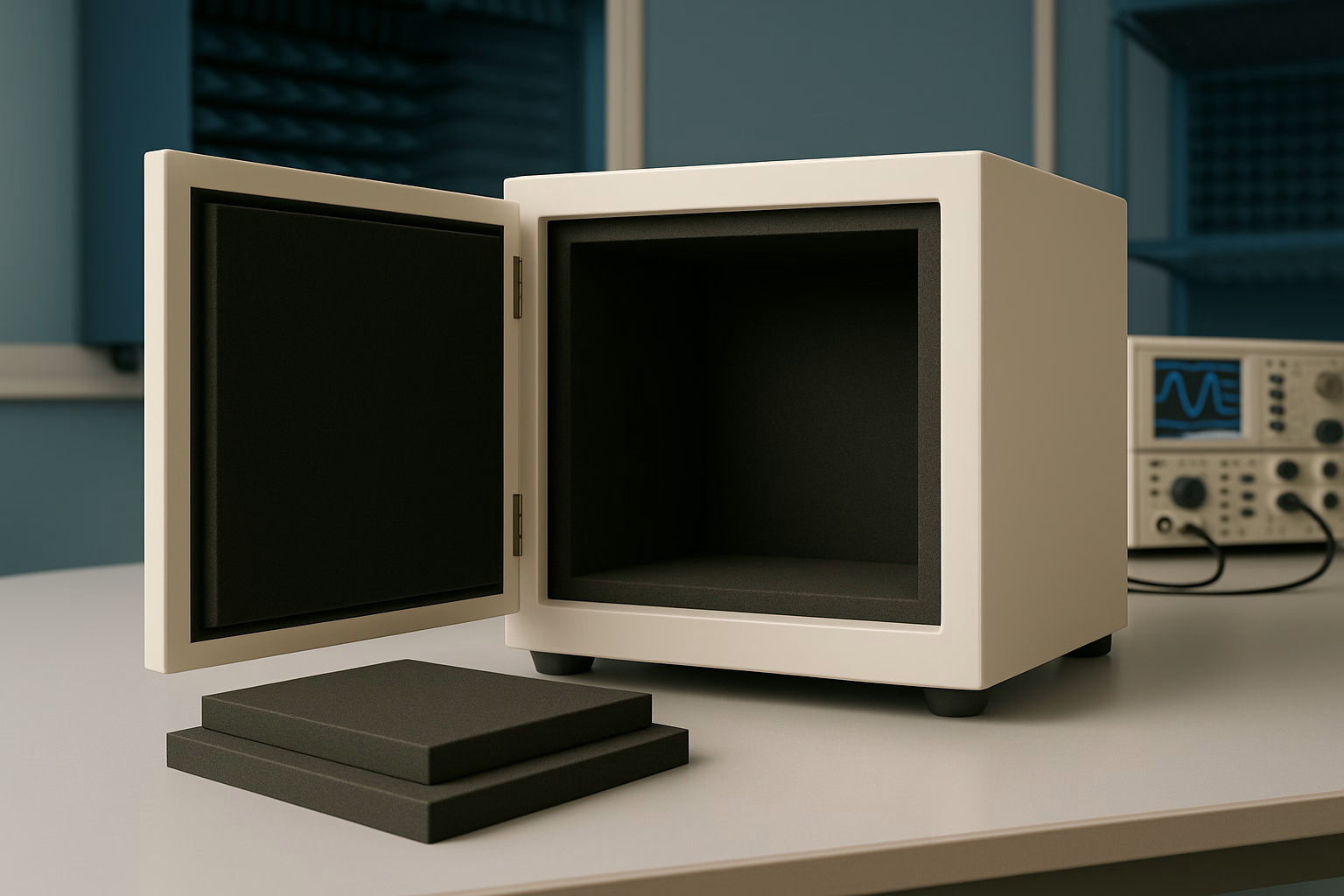
Short version: RF absorber foam (also called microwave absorber foam or RF absorbent foam) is a carbon-loaded polyurethane material that absorbs electromagnetic energy across a broad frequency range. There are several distinct types, and they work through different mechanisms, come in different form factors, and solve different problems. This guide explains how each type works, where it fits, and how to choose. 3PB Solutions manufactures broadband lossy foam, reticulated foam, and weatherproof PIM mitigation foam, and can source pyramidal and conical foam for customers who need it. Keep reading for the full comparison.
Need extra help? Contact our engineering team for a rapid response.
How RF Absorber Foam Works
All RF absorber foams share the same basic physics. An open-cell polyurethane foam matrix is loaded with carbon-based material. When electromagnetic energy passes through the foam, the carbon particles interact with the electric field component of the wave and convert RF energy into a small amount of heat through resistive (dielectric) losses. The foam structure itself also scatters the wave, increasing the path length through the lossy material and improving absorption.
What separates different foam types is how the carbon is distributed through the material, what shape the foam takes, and whether it needs a conductive backing to function. These differences determine the frequency range, the reflection performance, and the applications each type is suited for.
RF absorber foam is fundamentally different from the magnetically loaded elastomer sheet absorbers (like the US Series or the iron-loaded silicone series) used for cavity resonance suppression inside electronic enclosures. Foam absorbers work through dielectric loss and are designed for free-space applications where the wave is traveling through the air before hitting the material. Elastomer sheet absorbers work through magnetic loss and are designed to be placed directly on conductive surfaces inside shielded cavities. Different tools for different jobs.
Lossy Foam (Homogeneous Carbon-Loaded Foam)
Lossy foam is the simplest type of RF absorber foam. The carbon loading is uniform throughout the entire material volume. Every part of the foam has the same concentration of carbon, so the wave is attenuated steadily as it travels through the material.
How it works. When an electromagnetic wave hits the front face of a lossy foam sheet, some energy is reflected at the surface (because there’s an impedance mismatch between free space and the loaded foam) and the rest enters the material. As the wave travels through the foam, the carbon loading absorbs energy progressively. Thicker material absorbs more. Higher carbon loading absorbs more per unit thickness. The performance is specified as insertion loss in dB per inch at a given frequency.
Key characteristic: no conductive backing required. Lossy foam absorbs energy as it passes through the material volume. It does not rely on a reflection from a metal surface behind it. This means it can be used in free-space applications where you need to attenuate a signal traveling between two points, or where you want to absorb energy on both sides of the material.
Applications. Lossy foam is used for signal isolation between antennas or RF systems, lining the interior of small pre-compliance test chambers and desktop shielded enclosures, reducing back lobes and side lobes in antenna assemblies, and providing broadband absorption in compact spaces where pyramidal foam is too bulky.
3PB Solutions product: The AF Series Broadband RF Absorber Foam is a carbon-loaded polyurethane foam designed for 1 to 40 GHz. Available in flat sheets at standard thicknesses from 0.125″ to 2.000″, with custom thicknesses available. Standard sheet sizes are 24″ x 24″ and 12″ x 12″. Available with or without PSA backing. The AF Series can also be die-cut to custom shapes and machined to 3D geometries from CAD files.
Performance scales with thickness and loading level. The AF-0125-650 (0.125″ thick) provides -65 dB/in insertion loss at 10 GHz. The AF-0250-850 (0.250″ thick) provides -85 dB/in at 10 GHz. Thicker variants like the AF-1000-450 (1.000″) and AF-2000-100 (2.000″) trade some dB-per-inch for greater total absorption at lower frequencies. Custom electrical loading levels are available to match specific attenuation requirements.
All AF Series foam products are halogen-free, RoHS/REACH compliant, and rated for -45 to +120°C operating temperature.
Reticulated Foam (Tapered Carbon-Loaded Foam)
Reticulated foam is engineered for a different job than lossy foam. Where lossy foam prioritizes absorption through the material volume, reticulated foam prioritizes low reflection at the front face. This makes it the right choice when you need the incoming wave to enter the material with minimal energy bouncing back toward the source.
How it works. The carbon loading in reticulated foam is tapered: lighter at the front face and heavier toward the back. The front face is impedance-matched close to free space (377 ohms), so the wave enters with very little reflection. As it travels deeper into the foam, the increasing carbon concentration absorbs more and more energy. The open-cell reticulated structure scatters the wave within the material, increasing the effective path length and improving absorption.
Key characteristic: requires a conductive backing. Reticulated foam is designed to be installed on a metal surface or conductive foil. The conductive backing creates a reflection that destructively interferes with any remaining energy at the front face, resulting in very low net reflection across a broad frequency range. Without the conductive backing, reticulated foam will not achieve its rated performance. 3PB Solutions can supply reticulated foam with a conductive foil backing pre-installed, or the customer can install it on their own metal surface.
Applications. Reticulated foam is used on outdoor test ranges, inside antenna measurement systems, on reflective surfaces where you need to minimize reflected energy, and in any application where low front-face reflection matters more than through-material insertion loss.
3PB Solutions product: The AF Series Reticulated RF Absorber Foam is a carbon-loaded, open-cell polyurethane foam serviceable up to and above 100 GHz. Available in flat sheets from 0.375″ to 1.250″ thickness. Standard sheet sizes are 24″ x 24″ and 12″ x 12″. Available with conductive ground plane, PSA backing, or both.
The minimum usable frequency depends on thickness. The AF-1250-RET (1.250″ thick) and AF-1000-RET (1.000″) work down to 4 GHz. The AF-0750-RET (0.750″) works from 5 GHz. The AF-0500-RET (0.500″) from 8 GHz. The AF-0375-RET (0.375″) from 10 GHz. All thicknesses provide -20 to -40 dB attenuation above their minimum frequency when installed on a conductive backing.
All reticulated foam products are halogen-free, RoHS/REACH compliant, and rated for -45 to +120°C operating temperature.
Pyramidal Foam
Pyramidal foam absorbers are the tall, dark cones that line the walls of anechoic chambers. They’re the most recognized type of RF absorber foam, and for good reason: they provide the best broadband absorption performance of any foam geometry, particularly at lower frequencies where other foam types struggle.
How it works. The pyramid shape creates a gradual impedance transition from free space at the tips to the fully loaded foam at the base. The tips have very little material (mostly air), so they present an impedance close to free space. As the wave travels down the pyramid, the cross-section of foam increases and the wave encounters progressively more lossy material. By the time it reaches the base, most of the energy has been absorbed. Any remaining energy hits the back wall (usually metal) and makes a second pass through the pyramid on the way back out, getting absorbed further.
Key characteristic: size determines low-frequency performance. The height of the pyramid determines the lowest frequency the absorber can handle effectively. Taller pyramids absorb lower frequencies. A 12″ pyramid might work down to 1 GHz, while a 36″ pyramid can extend performance into the hundreds of MHz range. This is why large anechoic chambers have floor-to-ceiling pyramids that can be several feet tall.
Applications. Pyramidal foam is used almost exclusively in anechoic chambers and antenna measurement facilities where the absolute lowest reflection coefficient is required. Semi-anechoic chambers (used for EMC compliance testing) typically use pyramidal absorbers on the walls and ceiling with a reflective metal floor. Fully anechoic chambers line all surfaces including the floor. Pyramidal foam is also used in compact antenna test ranges and radar cross-section measurement facilities.
3PB Solutions does not manufacture pyramidal foam absorbers but can source them for customers who need pyramidal foam as part of a chamber project or antenna measurement setup. Contact us with your chamber dimensions and frequency requirements.
Conical Foam
Conical foam absorbers work on the same principle as pyramidal foam but use a cone shape instead of a four-sided pyramid. The tapered geometry provides a gradual impedance transition from free space to the fully loaded base.
How it works. The physics is identical to pyramidal foam. The cone shape provides a smooth impedance taper that minimizes reflection. The round cross-section can provide slightly more uniform performance across different polarizations compared to the square pyramid shape, which can show minor variations depending on the orientation of the incoming wave relative to the pyramid edges.
Applications. Conical absorbers are used in the same environments as pyramidal foam: anechoic chambers, antenna measurement systems, and radar cross-section facilities. They’re sometimes preferred in applications where polarization-independent performance is critical, or where the cone geometry better fits the mounting arrangement.
3PB Solutions can source conical foam absorbers for customers who need them. Contact us with your requirements.
Convoluted (Egg Crate) Foam
Convoluted foam, sometimes called egg crate foam because of its wavy surface pattern, is a compromise between the flat sheet and the full pyramid. The undulating surface creates a partial impedance taper that improves reflection performance compared to a flat sheet, but in a much thinner profile than pyramidal or conical absorbers.
How it works. The peaks and valleys of the convoluted surface create a gradual transition zone where the incoming wave encounters a mix of air and foam. This reduces front-face reflection compared to a flat sheet of the same base thickness. The absorption isn’t as deep as a full pyramid of equivalent height, but it’s significantly better than a flat surface, and the overall absorber is much thinner.
Applications. Convoluted foam is used in applications where some reflection performance improvement is needed but the available space won’t accommodate full pyramids. Compact test chambers, equipment enclosures, and retrofit installations where headroom is limited are common applications. It’s also used as a cost-effective alternative to pyramidal foam in less demanding chamber applications where -20 to -30 dB reflection performance is acceptable rather than the -40 to -50 dB that pyramids can achieve.
3PB Solutions can source convoluted foam absorbers for customers who need them. Contact us with your requirements.
PIM Mitigation Foam
PIM mitigation foam is a specialized application of RF absorber foam designed specifically for wireless carriers and antenna system operators dealing with passive intermodulation (PIM) interference. PIM occurs when RF signals from multiple carriers mix at non-linear junctions (corroded connectors, metal-to-metal contacts, rusty hardware) near antenna installations, generating unwanted intermodulation products that fall into receive bands and degrade system performance.
How it works. RF absorber foam panels are installed around antenna mounting hardware, tower structures, and nearby metallic surfaces that can act as PIM sources. The foam absorbs the reflected and scattered RF energy that would otherwise bounce off these surfaces and interact at non-linear junctions. By reducing the ambient RF energy near the antenna, the foam reduces the amplitude of the intermodulation products.
Key characteristic: weatherproof construction. Unlike laboratory foam absorbers that operate in controlled indoor environments, PIM mitigation foam must survive outdoor installation on cell towers, rooftops, and antenna poles. The foam panels are wrapped in Herculite fabric, a PVC-laminated polyester material that meets MIL-C-43006/55308 Type 2. This makes the panels waterproof, UV-resistant, flame-retardant, rot-resistant, and tear-resistant. The panels hold up to years of outdoor exposure including rain, snow, wind, and direct sunlight.
Applications. PIM mitigation is the fastest-growing segment of the RF absorber foam market. Major wireless carriers deploy these panels on 3G, 4G/LTE, and 5G macro cell and small cell antenna installations to improve network performance. The panels are installed around mounting hardware, tower legs, and nearby reflective surfaces using pressure-sensitive adhesive backing with velcro straps to ensure the installation meets wind load requirements. Panels can be up to 36″ in any one direction, but most deployments use kits of 2 to 4 smaller pieces that are puzzled together to fit around the specific mounting hardware on each antenna pole.
3PB Solutions product: The PM Series PIM Mitigation Materials are fabric-wrapped RF absorber foam panels covering 0.5 to 40 GHz. Available in thicknesses from 0.500″ to 2.000″ with standard 24″ x 24″ panels and custom dimensions up to 36″ in any direction. Custom kits are designed for specific antenna mounting configurations.
Performance data for the PM Series: the PM-0500-700 (0.500″ thick) provides -70 dB/in insertion loss at 10 GHz. The PM-1000-450 (1.000″) provides -45 dB/in. The PM-2000-100 (2.000″) provides -10 dB/in, trading attenuation per inch for greater total absorption at lower frequencies. All PM Series materials are rated for -45 to +120°C operating temperature.
Foam Type Comparison
This table summarizes the key differences between RF absorber foam types. Use it to narrow your selection before requesting samples.
| Foam Type | Carbon Loading | Conductive Backing | Form Factor | Best For |
|---|---|---|---|---|
| Lossy (homogeneous) | Uniform throughout | Not required | Flat sheet | Signal isolation, small chambers, antenna lobe reduction, compact spaces |
| Reticulated (tapered) | Tapered (light to heavy) | Required | Flat sheet | Low-reflection absorption, test ranges, antenna measurement, reflective surface treatment |
| Pyramidal | Uniform or tapered | Typically backed | Tall cones/pyramids | Anechoic chambers, antenna measurement, lowest achievable reflection |
| Conical | Uniform or tapered | Typically backed | Tall cones | Anechoic chambers, polarization-sensitive applications |
| Convoluted (egg crate) | Uniform | Optional | Wavy sheet | Compact chambers, retrofit, space-constrained installations |
| PIM mitigation | Uniform | Not required | Weatherproof panel | Cellular antenna PIM reduction, outdoor tower installations |
How to Choose the Right RF Absorber Foam
Start with the application. The environment determines the foam type more than the frequency does.
If you need to isolate signals between two antennas or systems in free space, or line a small pre-compliance chamber or desktop shielded enclosure, start with lossy foam. It works without a conductive backing and attenuates energy passing through it in any direction.
If you need to minimize reflected energy from a surface (like a wall, a ground plane, or a piece of test equipment), use reticulated foam installed on that surface. The tapered loading and impedance-matched front face give you the lowest reflection in a flat-sheet form factor.
If you’re building or lining an anechoic chamber and need the absolute best reflection performance across the widest bandwidth, pyramidal or conical foam is the standard. The choice between pyramid and cone comes down to polarization requirements and mounting geometry.
If you have limited space but still need better reflection performance than a flat sheet, convoluted foam gives you a middle ground.
If you’re a wireless carrier or antenna system operator dealing with PIM interference on a tower or rooftop installation, PIM mitigation foam is the purpose-built solution.
Then check thickness. For lossy and reticulated foam, thicker material absorbs at lower frequencies. If your application operates at 2 GHz, you’ll need more material than if it operates at 10 GHz. The datasheets for 3PB Solutions foam products include performance curves across frequency for each available thickness, so you can match the material to your specific frequency requirement.
Consider the environment. All 3PB Solutions foam products are rated for -45 to +120°C. For outdoor installations, the PM Series PIM Mitigation materials are wrapped in MIL-PRF-20696F weatherproof fabric. For indoor applications, the AF Series lossy and reticulated foam products are suitable as-is. Polyurethane foam is not recommended for prolonged outdoor UV exposure without a protective covering.
Bonding and Installing RF Absorber Foam
Most foam absorber installations use one of three attachment methods: pressure-sensitive adhesive (PSA) backing, contact adhesive applied at installation, or mechanical attachment.
PSA backing. The AF Series lossy foam and reticulated foam are both available with acrylic PSA backing applied at the factory. Peel the liner and press the sheet onto a clean, dry surface. PSA backing is the fastest option for enclosure lining, test fixture treatment, and prototype work, and it holds reliably in indoor environments across the full -45 to +120°C operating range of the foam.
Does the adhesive affect RF performance? No, when installed as intended. For lossy foam, the PSA sits on the mounting face, where the wave has already passed through the absorbing volume. For reticulated foam, the adhesive layer sits between the heavily loaded back face and the conductive backing; the layer is thin relative to wavelength and has no measurable effect. What does matter for reticulated foam is intimate, continuous contact with the conductive surface. Air gaps, wrinkles in a foil backing, or debris between the foam and the metal will degrade the rated reflection performance, so surface preparation matters more than adhesive selection.
Conductive backing options. Reticulated foam can be supplied with a conductive foil ground plane pre-installed, with PSA, or with both. If you are installing onto an existing metal surface, order without the foil and mount directly. If the mounting surface is non-conductive (plastic, wood, drywall in a chamber build), order the foil-backed version so the ground plane travels with the material.
Large-area and outdoor installations. For chamber lining projects covering large wall areas, a sprayable or brushable contact adhesive is typical; verify compatibility with polyurethane foam before committing to a full install, and test one panel first. For the PM Series PIM mitigation panels used outdoors, installation combines PSA backing with velcro straps so the panels meet wind load requirements on towers and rooftops.
Cutting and shaping. All AF Series foam can be die-cut to custom outlines or machined to 3D geometries from CAD files, so complex fits around connectors, standoffs, and mounting hardware can be delivered ready to install rather than trimmed in the field.
How Much Does RF Absorber Foam Cost?
RF absorber foam is priced per sheet, and cost is driven by five factors: foam type (lossy, reticulated, or fabric-wrapped PIM panel), thickness, carbon loading level, sheet size, and options such as PSA backing, conductive foil, or custom die-cutting.
As a rough planning guide, AF Series lossy foam sheets run $125 to $250 per 24″ x 24″ sheet in prototype quantities depending on thickness, and reticulated foam from $150 per sheet depending on thickness and backing options. PM Series PIM mitigation panels are quoted per kit based on the antenna mounting configuration. Pyramidal and conical absorbers are quoted per project based on chamber dimensions and frequency requirements. Volume pricing applies to production quantities.
The fastest way to get exact numbers is to request a quote with your frequency range, thickness, and quantity. If you are still narrowing down the material, order a free sample kit first and evaluate before committing to a production buy.
RF Absorber Foam vs. Elastomer Sheet Absorbers
Engineers sometimes ask whether they should use foam or an elastomer sheet absorber for a given application. The answer depends on the problem you’re solving.
Use foam when you need broadband absorption in free space: isolating antennas, lining chambers, reducing reflections from surfaces, or mitigating PIM on outdoor antenna installations. Foam absorbers are thicker, lighter, and work through dielectric loss. They’re designed for applications where the electromagnetic wave is traveling through the air before hitting the material.
Use elastomer sheets (like the US Series or the LS/CB/XB/KU/KB/KA Series) when you need to suppress cavity resonance, reduce coupling between components on a PCB, or attenuate surface currents inside a shielded enclosure. Elastomer sheets are thin, flexible, magnetically loaded, and work through magnetic loss. They’re designed to be placed directly on conductive surfaces inside electronic devices.
Some applications benefit from both. An antenna system might use foam absorbers for signal isolation between antenna elements while also using elastomer sheet absorbers inside the electronics housing to suppress cavity resonance. 3PB Solutions manufactures both product categories and can recommend the right combination for your application.
Getting Started
The fastest way to evaluate RF absorber foam is to request a free sample kit. Tell us your application, frequency range, and whether you need lossy foam, reticulated foam, PIM mitigation panels, or aren’t sure. We’ll send the right materials to test.
For chamber lining projects, antenna system installations, or PIM mitigation deployments, email our engineering team with your project details and we’ll recommend the right foam type, thickness, and configuration.
For customers who need pyramidal, conical, or convoluted foam, 3PB Solutions can source and supply these materials as part of a complete absorber package. Contact us with your requirements.
Quick Contact: Call (855) 785-5660 or email sales@3pbsolutions.com.
Product Finder: Search by frequency, thickness, and base material to find the right part number.
Frequently Asked Questions
RF absorber foam (also called microwave absorber foam, RF absorbent foam, or RF absorbing foam) is a carbon-loaded polyurethane foam material that absorbs electromagnetic energy and converts it to heat through dielectric loss. It is used in anechoic chambers, antenna systems, test ranges, signal isolation applications, and PIM mitigation installations. Different foam types (lossy, reticulated, pyramidal, conical, and convoluted) are optimized for different applications based on their carbon loading profile and physical geometry.
Lossy foam has uniform carbon loading throughout the material and does not require a conductive backing. It absorbs energy as it passes through the foam volume and is used for signal isolation and small chamber lining. Reticulated foam has tapered carbon loading (lighter at the front, heavier at the back) and must be installed on a conductive backing. The tapered loading creates an impedance-matched front face for minimal reflection. Reticulated foam is used on test ranges and reflective surfaces where low reflection is the priority.
3PB Solutions manufactures three categories of RF absorber foam: the AF Series Broadband Foam (1 to 40 GHz lossy foam in thicknesses from 0.125″ to 2.000″), the AF Series Reticulated Foam (4 to 100+ GHz reticulated foam in thicknesses from 0.375″ to 1.250″), and the PM Series PIM Mitigation Materials (0.5 to 40 GHz weatherproof foam panels for outdoor antenna installations). All products are available in standard sheets and custom die-cut shapes. 3PB Solutions can also source pyramidal, conical, and convoluted foam for customers who need these geometries. Request a sample kit to evaluate in your application.
The 3PB Solutions PM Series PIM Mitigation Materials are weatherproof RF absorber foam panels designed specifically for outdoor antenna installations on cell towers and rooftops. The foam is wrapped in Herculite fabric meeting MIL-C-43006/55308 Type 2, making it waterproof, UV-resistant, flame-retardant, and tear-resistant. Panels are available from 0.500″ to 2.000″ thick in sizes up to 36″ in any direction. Most deployments use custom kits of 2 to 4 pieces designed to fit around specific antenna mounting hardware. Installation uses PSA backing with velcro straps for wind load security.
Foam absorbers are designed for free-space applications, not for placement inside tight electronic enclosures. For cavity resonance suppression and EMI control inside shielded enclosures, magnetically loaded elastomer sheet absorbers are the right choice. The 3PB Solutions US Series (non-silicone acrylic, 0.5 to 18 GHz) and the iron-loaded silicone series (LS through KA, 1 to 40 GHz) are designed specifically for this application. See our cavity resonance guide for details.
RF absorber foam is priced per sheet, with cost driven by foam type, thickness, carbon loading level, sheet size, and options such as PSA backing, conductive foil, or die-cutting. AF Series lossy and reticulated foam ship in standard 24″ x 24″ and 12″ x 12″ sheets, and volume pricing applies to production quantities. Request a quote with your frequency range and thickness for exact pricing, or order a free sample kit to evaluate the material first.
Yes. AF Series lossy foam and reticulated foam are available with factory-applied acrylic PSA backing, and reticulated foam can also be supplied with a conductive foil ground plane, or both. The adhesive layer does not measurably affect RF performance when the material is installed as directed. PM Series PIM mitigation panels combine PSA backing with velcro straps for outdoor wind load requirements. Q: Do you supply pyramidal RF absorber foam? A: Yes. 3PB Solutions does not manufacture pyramidal foam in-house but sources and supplies pyramidal, conical, and convoluted absorbers as part of complete absorber packages for anechoic chambers, antenna measurement systems, and RCS facilities. Contact us with your chamber dimensions and frequency requirements and we will recommend the right absorber geometry and size.
