
by 3PB Team
Share
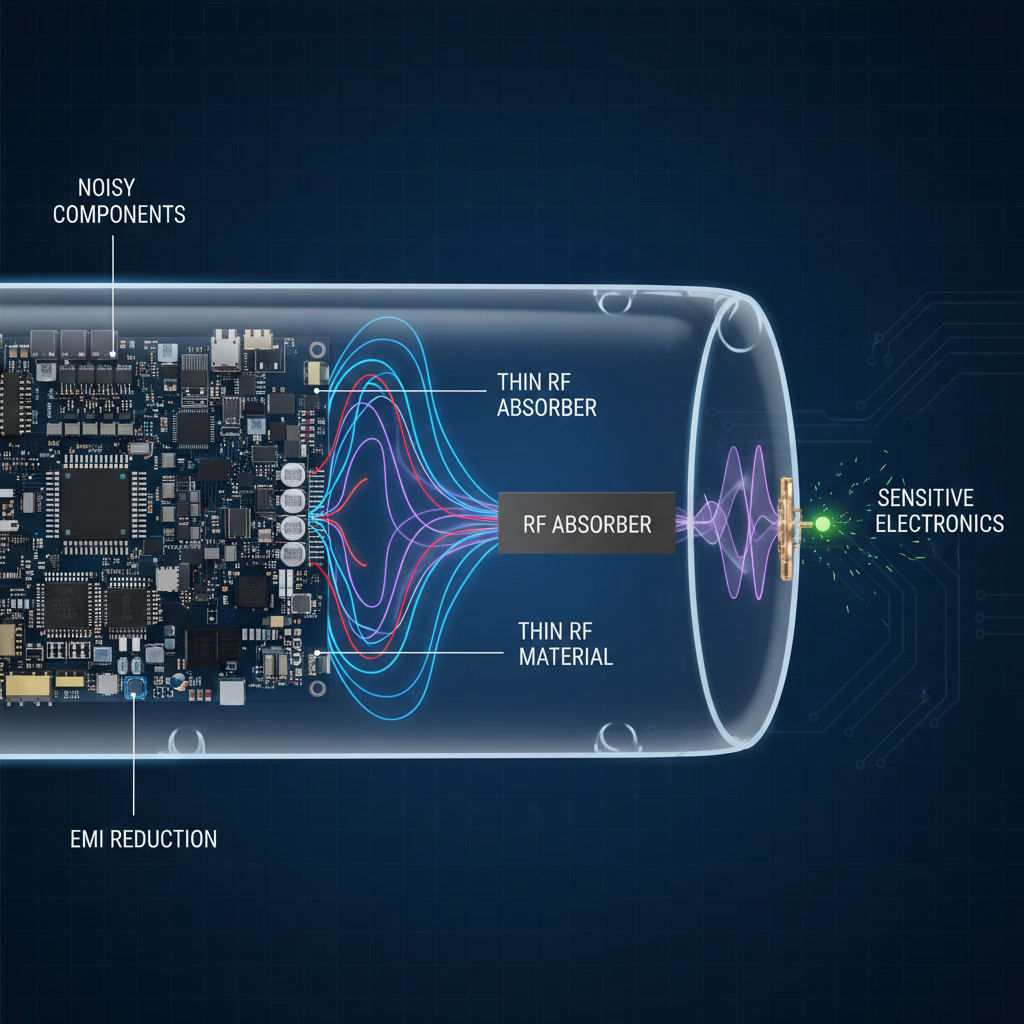
Short version: EMI shields and RF absorbers are not interchangeable. Shields reflect electromagnetic energy. Absorbers convert it to heat. Most designs need both, and using one without the other is the root cause of many EMI failures. This guide explains the physics of each, when to use which, and why the combination of a conductive shield plus an absorber lining is the standard approach for any enclosure operating above 1 GHz. Keep reading for the full breakdown.
Need extra help? Contact our engineering team for a rapid response.
The Fundamental Difference
An EMI shield is a conductive barrier. It works by reflecting electromagnetic energy away from (or containing it within) a space. Metals like copper, aluminum, and steel are effective shields because their high conductivity allows them to redirect electromagnetic fields. Board-level shield cans, conductive gaskets, and metallized enclosures are all shielding solutions. They create a Faraday cage around the protected or contained circuit.
An RF absorber is a lossy material. It works by converting electromagnetic energy into a small amount of heat through magnetic or dielectric loss mechanisms. The energy that enters the absorber does not reflect back. Instead, it dissipates within the material. Magnetically loaded elastomers, carbon-loaded foams, and ferrite tiles are all absorber materials.
The distinction matters because each mechanism has a limitation that the other solves.
The Shielding Paradox
A perfect shield would contain all electromagnetic energy inside the enclosure. In theory, this prevents emissions from escaping. In practice, it creates a new problem: the energy that was going to escape is now trapped inside the enclosure, bouncing between the conductive walls.
This is cavity resonance. At frequencies where the enclosure dimensions support standing waves, the trapped energy amplifies. Instead of containing the emissions, the shield has created a resonant cavity that concentrates energy at specific frequencies. Coupling between components inside the enclosure increases. Receiver sensitivity degrades. And the emissions that do escape through seams, apertures, or cable feedthroughs may actually be worse at resonant frequencies than they would be without the shield.
This is why engineers sometimes see a new emissions spike appear at the test lab when the shield lid goes on. The shield is working exactly as designed. It is reflecting energy. The problem is that reflected energy is now resonating inside the cavity.
The Absorber Solution
An RF absorber placed inside the shielded enclosure dissipates the trapped energy instead of letting it resonate. The shield still contains the emissions. The absorber prevents the contained energy from amplifying at resonant frequencies. The combination of shield plus absorber is more effective than either alone.
This is the standard approach in modern electronic design. Every board-level shield can should have absorber material on the lid. Every shielded enclosure operating above 1 GHz should be evaluated for cavity resonance and treated with absorber material if resonances fall within the operating or emissions frequency range. EMC compliance failures that appear only when the shield is assembled are almost always a sign that absorber material is needed.
When You Need Only a Shield
At low frequencies (below a few hundred MHz), most enclosures are too small relative to the wavelength to support cavity resonance. A shield alone is sufficient because the cavity effect does not manifest. Low-frequency magnetic shielding with mu-metal or similar materials is also purely a shielding application where absorbers are not relevant.
When You Need Only an Absorber
In free-space applications like anechoic chambers, antenna test ranges, and PIM mitigation at cell sites, there is no enclosure to create a cavity. The absorber is placed on surfaces to prevent reflections from degrading the measurement or system performance. No shield is involved.
When You Need Both
Any shielded enclosure operating at frequencies where cavity resonance is possible needs both. For a typical board-level shield can measuring 1″ × 1″ × 0.25″, the first resonance falls somewhere around 4 to 8 GHz. For consumer electronics operating with Wi-Fi (2.4 and 5 GHz), Bluetooth (2.4 GHz), 5G sub-6 (3.3 to 5 GHz), and various harmonics, cavity resonance is almost guaranteed in any shielded enclosure. The absorber material on the shield lid is not optional. It is a fundamental part of the shielding system.
The US Series (0.5 to 3.0 GHz, usable to 18 GHz) is the most commonly specified material for this application because its broad frequency range covers the bands where most consumer and commercial electronics operate. For higher-frequency applications, the frequency-specific series from LS through KA provide targeted absorption where you need it. Our frequency selection guide maps each frequency band to the right product.
Near-Field vs. Far-Field: A Common Mistake
One more distinction matters: near-field versus far-field absorber applications. A board-level shield cavity is a near-field problem. The absorber sits millimeters from the source, and what matters is the magnetic loss tangent of the material at the operating frequency. A far-field problem, like an anechoic chamber wall or an RCS reduction surface, is about reflection loss measured from the air-material interface. The two applications use different absorber types, and swapping one for the other does not work. A material tuned to minimize radar reflections at 10 GHz will not perform well as a cavity resonance absorber at the same frequency. Match the material to the application, not just the frequency.
Getting Started
Request a free sample kit to test absorber materials in your shielded enclosure. Include the failure frequency from your emissions scan or the operating frequency of the circuit inside the shield, and we will send the right materials for your evaluation.
Quick Contact: Call (855) 785-5660 or email sales@3pbsolutions.com.
Product Finder: Search by frequency, thickness, and base material to find the right part number.
Frequently Asked Questions
In most cases, yes. A conductive shield contains electromagnetic energy by reflecting it, but that reflected energy can resonate inside the enclosure at specific frequencies (cavity resonance). An RF absorber placed inside the shield dissipates this energy, preventing the resonance that causes emissions spikes and component coupling. Above 1 GHz, the combination of shield plus absorber is the standard approach.
This is classic cavity resonance. The shield creates a resonant cavity that amplifies electromagnetic energy at frequencies where the enclosure dimensions support standing waves. The solution is to place RF absorber material inside the enclosure to dampen the resonance. The US Series is the most common starting material for this fix.
EMI shielding uses conductive materials (metals, metallized plastics) to reflect and redirect electromagnetic energy, creating a barrier. RF absorbing uses lossy materials (magnetically or dielectrically loaded elastomers, foams, ferrites) to convert electromagnetic energy into heat. Shields block by reflection. Absorbers eliminate by dissipation. Most high-frequency electronic designs benefit from using both together.
