
by 3PB Team
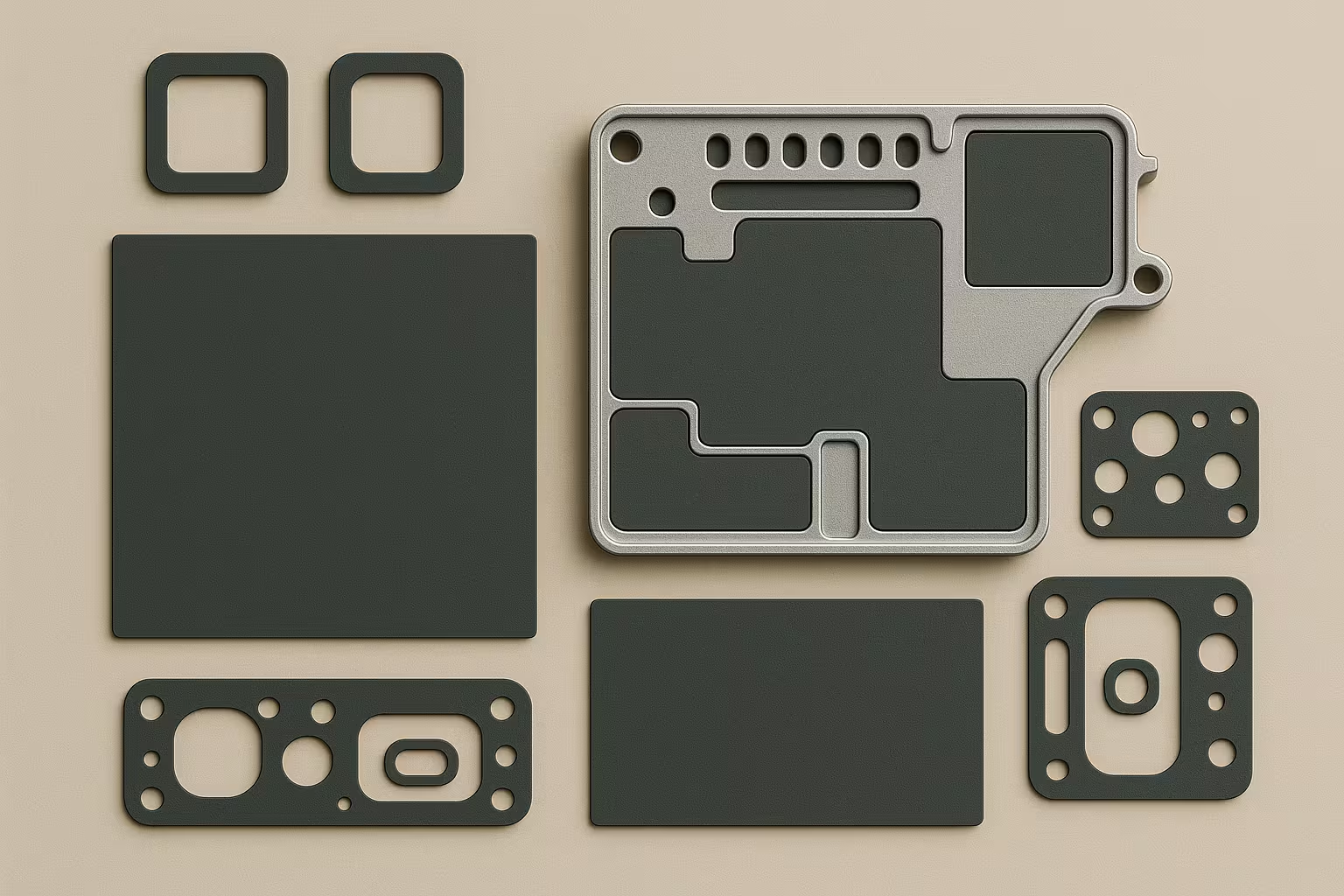
Short version: The single most important factor in choosing an RF absorber is the frequency you need to absorb. Every absorber material is optimized for a specific frequency range, and using the wrong one wastes time and money. This guide provides a straightforward frequency-to-product mapping for the full 3PB Solutions line from 0.5 GHz to 100+ GHz, plus the decision framework for choosing between material types. Keep reading for the complete selection guide.
Need extra help? Contact our engineering team for a rapid response.
Start with the Frequency
Before anything else, identify the frequency or frequency range you need to address. If it is an emissions failure, look at the test scan and find the spike frequency. If it is a cavity resonance issue, calculate the resonant frequency from the enclosure dimensions. If it is a design requirement, identify the operating frequency of the circuit that needs protection.
This frequency determines which absorber material gives you the best result. Absorber materials are not broadband catch-all solutions. Each formulation is tuned for a specific frequency range through its magnetic filler loading, elastomer thickness, and magnetic loss tangent profile. The magnetic loss tangent (the ratio of imaginary to real permeability) tells you where the material is most effective: peak values at your target frequency mean maximum attenuation. Using an absorber outside its intended frequency range gives poor results.
This guide walks the selection logic band by band; the RF absorber materials overview shows every series side by side.
Application-Specific Starting Points
If you already know your application category, our application guides recommend specific materials to start with:
- EMC compliance failures: See the EMC compliance guide.
- 5G FR2 and mmWave: See the 5G mmWave guide.
- Automotive radar (24/77/79 GHz): See the automotive radar guide.
- Satellite Ku/Ka-band: See the satellite communications guide.
- Medical devices (IEC 60601): See the medical device guide.
- Defense and aerospace: See the defense and aerospace guide.
- Thermal management + EMI: See the thermal pad absorber guide.
The 3PB Solutions Frequency Map
US Series (0.5 to 3.0 GHz, usable to 18 GHz): Iron-loaded acrylic elastomer. The only non-silicone option. 0.010″, 0.020″, and 0.040″ thicknesses. Best for sub-6 GHz applications and silicone-free environments. This is the first material to try for most EMC compliance failures because its broad usable range covers the frequencies where cavity resonance is most common in consumer electronics.
LS Series (1.0 to 4.0 GHz): Iron-loaded silicone elastomer. Up to 0.125″ thick. Designed for applications in the lower GHz range where more material thickness provides additional attenuation. Common in cellular infrastructure equipment and industrial electronics.
CB Series (4.0 to 8.0 GHz): Iron-loaded silicone elastomer optimized for C-band. Used in satellite communications equipment, radar systems operating in C-band, and electronics with cavity resonances in the 4 to 8 GHz range.
XB Series (8.0 to 12.0 GHz): Covers X-band. Used in military radar, satellite communications, and any application with EMI concerns in the 8 to 12 GHz range.
KU Series (12.0 to 18.0 GHz): At 0.045″ thick. Covers Ku-band satellite, VSAT terminals, and 5G backhaul systems operating in this range.
KB Series (18.0 to 27.0 GHz): At 0.042″ thick. Covers K-band, 5G FR2 band n258 (24.25 to 27.50 GHz), point-to-point backhaul links, and 24 GHz automotive radar.
KA Series (27.0 to 40.0 GHz): At 0.037″ thick. The thinnest elastomer in the line. Covers 5G FR2 bands n257 (26.50 to 29.50 GHz), n260 (37.00 to 40.00 GHz), and n261 (27.50 to 28.35 GHz), plus Ka-band satellite communications.
TF Series (2.0 to 18.0 GHz): Narrowband frequency-specific elastomer. Each TF part number is a specific formulation and thickness combination selected to deliver maximum attenuation at an exact target frequency within the 2–18 GHz range. When you know the exact problem frequency and need every dB of performance at that point, TF delivers higher peak absorption than the broadband series.
AF Series Broadband Foam (1.0 to 40.0 GHz): Carbon-loaded polyurethane foam for free-space applications. Used in test fixtures, chamber linings, and antenna pattern control.
AF Series Reticulated Foam (4.0 to 100+ GHz): Open-cell reticulated foam for millimeter-wave applications. Covers automotive radar at 77 GHz, W-band, and emerging sub-THz frequencies.
DU Series (2.0 to 18.0 GHz): Thermal pad absorber for applications requiring both heat dissipation and EMI absorption in a single material.
AC-001 Series (1.0 to 40.0 GHz): Dispensable liquid silicone absorber for automated production environments.
Decision Framework: Sheet vs. Foam vs. Dispensable
If the absorber goes on a conductive surface inside an enclosure (shield lid, housing wall, cavity floor), use a sheet absorber. The elastomer sheets are designed for backed applications where one side contacts a conductor.
If the absorber is in the signal path between systems (not inside an enclosure), use a foam absorber. Foams are designed for free-space applications where the wave passes through the material.
If you are placing absorber in dozens of small cavities in a production environment, use the dispensable absorber to eliminate manual placement labor.
Getting Started
Request a free sample kit with materials matched to your frequency range. Include your failure frequency or operating frequency in the request and we will send the right materials. Or use the Product Finder to search by frequency, thickness, and base material.
Quick Contact: Call (855) 785-5660 or email sales@3pbsolutions.com.
Product Finder: Search by frequency, thickness, and base material to find the right part number.
Frequently Asked Questions
Start with the US Series (0.5 to 3.0 GHz, usable to 18 GHz). Its broad frequency range covers the most common cavity resonance frequencies in consumer electronics. If your failure is in a specific band between 1 and 18 GHz and you need maximum attenuation, step up to the frequency-specific silicone series (LS, CB, XB, or KU) for that band. For failures above 18 GHz, use the KB or KA Series. Send us your emissions scan data and we will recommend the right material.
Sheet absorbers (magnetically loaded elastomers) are designed to be placed on conductive surfaces inside enclosures. They work through magnetic loss and suppress cavity resonance. Foam absorbers (carbon-loaded polyurethane) are designed for free-space applications where the wave travels through air before hitting the material. They work through dielectric loss and are used in anechoic chambers, test fixtures, and antenna applications.
The US Series (usable to 18 GHz) provides broadband coverage across multiple bands for in-device applications. For applications above 18 GHz, the frequency-specific series (KB, KA) provide optimized performance at their target bands. The AC-001 dispensable absorber covers 1.0 to 40.0 GHz for broadband automated applications. For known single-frequency problems between 2 and 18 GHz where maximum peak attenuation matters, the TF Series delivers the highest performance at a specific target frequency.
