
by 3PB Team
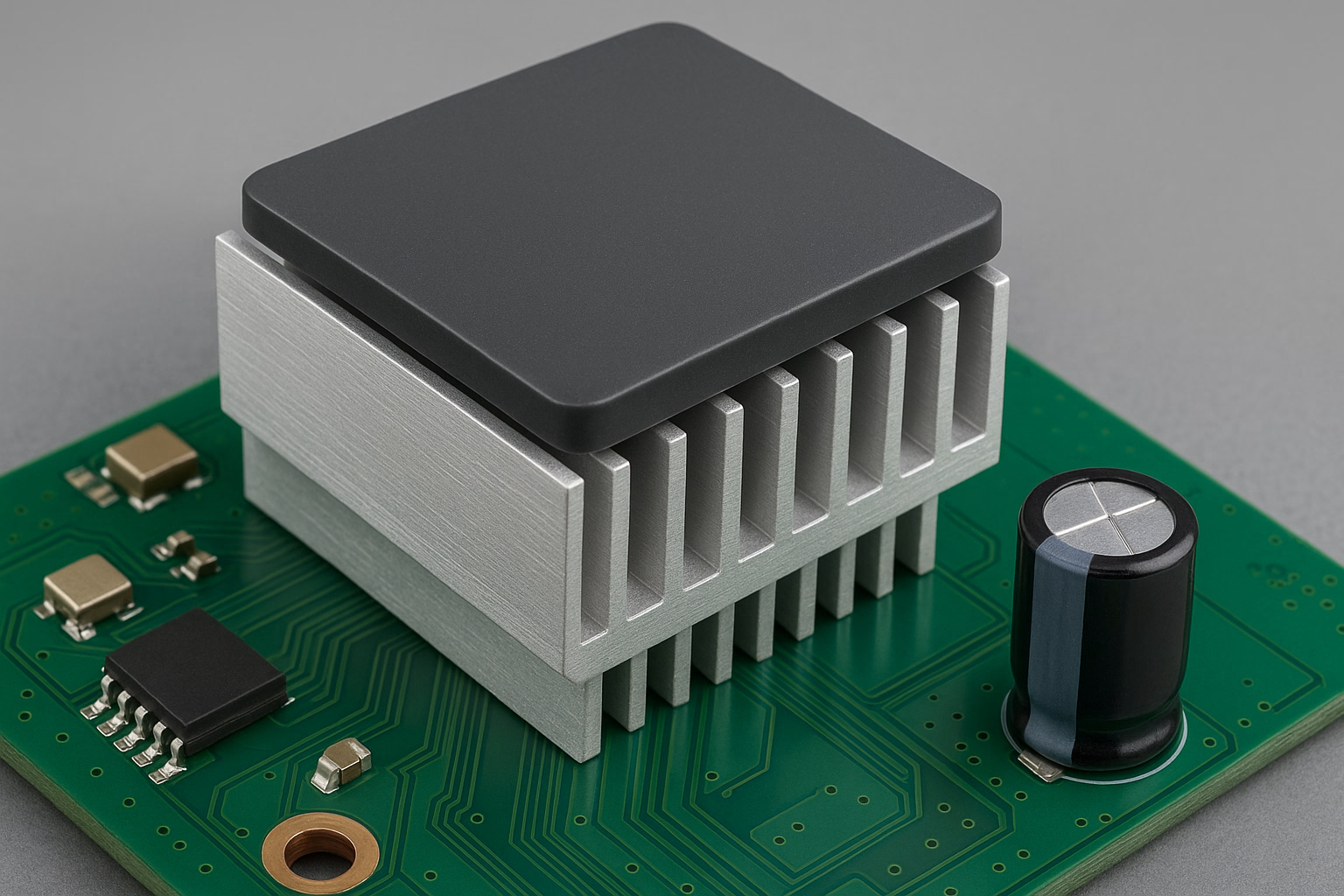
Short version: High-power electronics generate both EMI and heat, and the two problems usually occupy the same physical space. Traditional approaches treat them separately: a thermal pad for heat, an absorber for EMI. The 3PB Solutions DU Series combines both functions in a single material, providing RF absorption from 2 to 18 GHz while also conducting heat away from components. Keep reading for the full guide on managing thermal and EMI challenges simultaneously.
Need extra help? Contact our engineering team for a rapid response.
The Thermal-EMI Conflict
Modern electronics are getting smaller, faster, and hotter. Processors, power amplifiers, and RF transceivers generate significant heat that must be conducted to the enclosure or a heat sink. They also generate electromagnetic emissions that must be contained and absorbed. The component that needs thermal management is often the same component that needs EMI treatment, and both solutions compete for the same physical space between the component and the enclosure wall.
A traditional approach stacks a thermal pad between the component and the shield lid, with an RF absorber on the opposite side of the lid. This works but adds thickness, increases thermal resistance (because heat must pass through two materials and a metal layer), and complicates the mechanical design. In space-constrained applications like smartphones, wearables, and automotive modules, this dual-material approach may not physically fit.
The DU Series: Absorber and Thermal Pad in One
The 3PB Solutions DU Series is an RF absorber thermal pad designed to solve both problems simultaneously. It is a magnetically loaded elastomer that provides RF absorption from 2.0 to 18.0 GHz while also functioning as a thermal interface material. Place it between a heat-generating component and a metal surface, and it conducts heat while absorbing EMI.
This dual-function approach eliminates the stacked-material problem. One material replaces two, reducing total thickness, simplifying assembly, and potentially improving thermal performance by eliminating an interface layer.
When heat dissipation is not part of the requirement, a standard absorber is usually the simpler choice; compare the DU Series against the other RF absorber materials.
Thermal Conductivity and Thickness Options
The DU Series is available in two thermal conductivity grades: 1.5 W/mK and 2.5 W/mK. Both cover the full 2–18 GHz frequency range. Thickness selection is driven by the target frequency: 0.080″ for 2–6 GHz, 0.060″ for 6–10 GHz, 0.040″ for 10–14 GHz, and 0.020″ for 14 GHz and above. The higher thermal conductivity version moves more heat but has a slightly different RF absorption profile. Engineers typically select based on whether thermal performance or RF attenuation is the primary driver, then verify the other parameter meets requirements.
Both grades are soft, slightly compressible pads with self-tack on both faces. No adhesive backing is needed. The material stays in place through its natural tack and the compression of the assembly. This simplifies installation and eliminates adhesive-related thermal resistance at the interface.
Applications Where Thermal and EMI Overlap
This scenario is common in 5G base stations where power amplifiers run hot and generate broadband noise. It appears in automotive radar modules where the radar MMIC dissipates heat in a compact housing that also needs cavity resonance suppression. Consumer electronics with tightly packed SoCs, memory stacks, and power management ICs all face the same constraint: not enough room for separate thermal and EMI solutions.
Even in applications where space is not the primary constraint, the single-material approach simplifies the bill of materials and the assembly process. One part replaces two, which reduces cost, eliminates a potential assembly error, and ensures that both thermal and EMI performance are delivered by the same placement.
When to Use Separate Materials
The DU Series covers 2 to 18 GHz, which spans most of the frequencies where cavity resonance is an issue in typical electronic enclosures. For applications requiring absorption below 2 GHz or above 18 GHz, the standard elastomer absorbers (US, LS, CB, XB, KU, KB, KA Series) paired with a separate thermal pad may be necessary. See our frequency selection guide to match material to your operating frequency. For very high thermal loads requiring thermal conductivity beyond what the DU Series provides, a dedicated high-performance TIM may be needed alongside a separate absorber.
Getting Started
Request a free sample kit with DU Series thermal absorber pads. Include your operating frequency, thermal dissipation requirement, and available material thickness in your request.
Quick Contact: Call (855) 785-5660 or email sales@3pbsolutions.com.
Product Finder: Search by frequency, thickness, and base material to find the right part number.
Frequently Asked Questions
Yes. The 3PB Solutions DU Series is specifically designed as a dual-function material that provides RF absorption from 2 to 18 GHz while also conducting heat between a component and a metal surface. It replaces both a traditional thermal interface material and a separate RF absorber in a single layer.
The DU Series covers 2.0 to 18.0 GHz, which spans the frequency range where cavity resonance is most common in typical electronic enclosures. This covers Wi-Fi, Bluetooth, 5G sub-6 GHz, and most commercial frequency bands where EMI and thermal issues overlap.
